
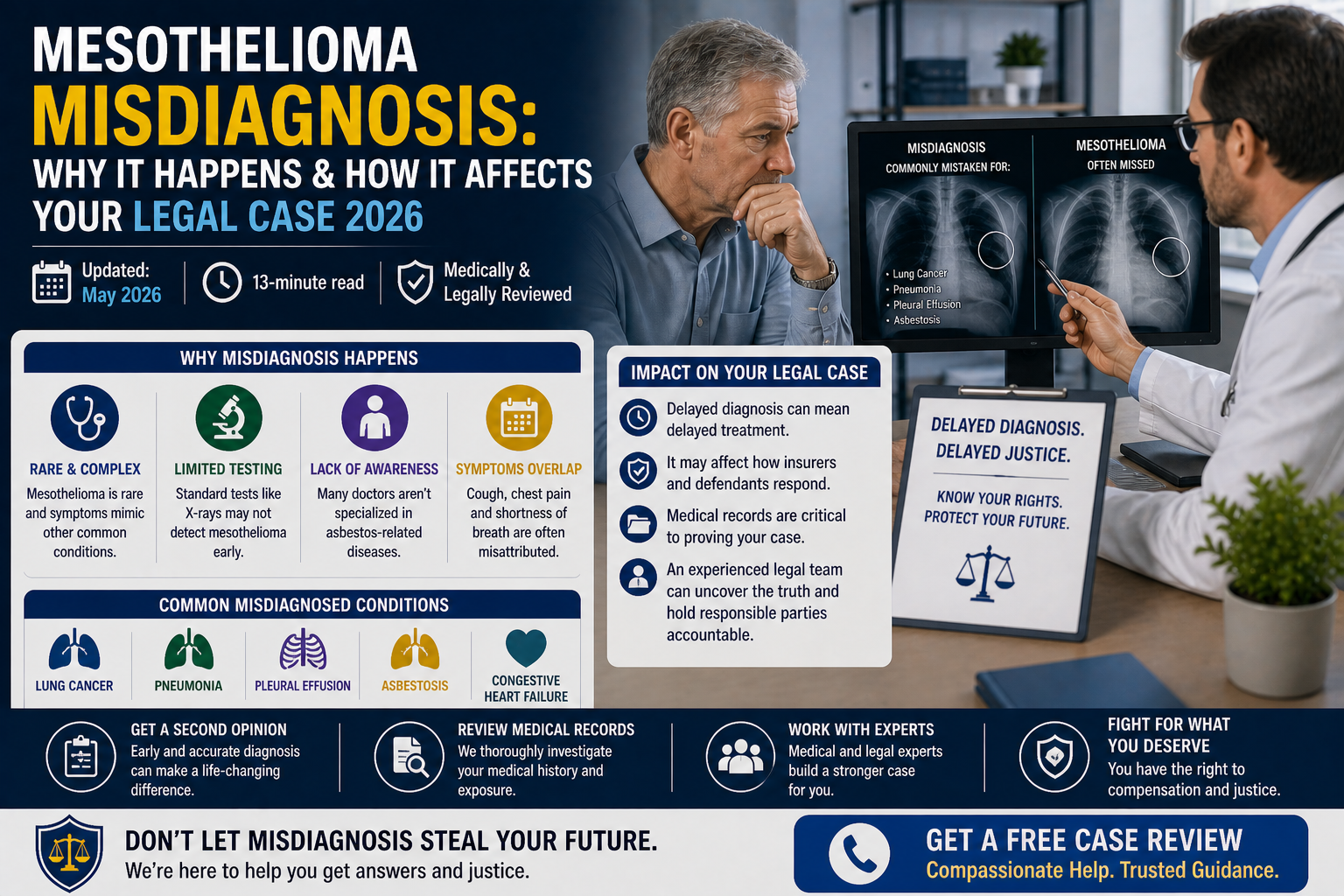
📅 Updated: May 2026 | ⏱ 13-minute read | ✅ Medically & Legally Reviewed
Introduction
Mesothelioma Misdiagnosis is one of the most frequently misdiagnosed cancers in medicine. Studies consistently show that up to 50% of mesothelioma cases are initially misdiagnosed, most commonly as lung cancer, pneumonia, pleural effusion of unknown cause, or other respiratory conditions. In some cases, patients spend months or even years being treated for the wrong disease before the correct diagnosis is made.
This matters enormously, not just medically, but legally.
A misdiagnosis or delayed diagnosis means delayed treatment, potentially allowing the disease to advance to a stage where surgical options are no longer available. It means months of the wrong medications, the wrong specialists, and the wrong conversations with family about what comes next. And it means the statute of limitations clock, which runs from the date of diagnosis, may be complicated by questions of when the disease was actually discovered and when the patient knew, or should have known, that asbestos exposure caused their illness.
This guide covers everything you need to know: why mesothelioma is so frequently misdiagnosed, which conditions it’s confused with, how a wrong diagnosis affects your legal rights, whether you have grounds for a medical malpractice claim, and exactly what steps to take right now to protect your compensation rights regardless of diagnostic history.
How Often Is Mesothelioma Misdiagnosed?
The statistics are striking:
- Up to 50% of mesothelioma cases are initially misdiagnosed, according to published medical literature
- Mesothelioma is misdiagnosed as lung cancer in the majority of initial misdiagnosis cases, the two cancers share overlapping symptoms and can look similar on initial imaging
- The average time from first symptoms to correct mesothelioma diagnosis is 3 to 6 months, and in many cases longer
- Peritoneal mesothelioma has an even longer diagnostic delay than pleural mesothelioma, its abdominal symptoms are frequently attributed to irritable bowel syndrome, Crohn’s disease, hernia, or ovarian cancer (in women)
- Even after biopsy, mesothelioma is misidentified at the pathology stage in a significant minority of cases, the cells can resemble adenocarcinoma or other cancer types under microscopy
Why Is Mesothelioma So Frequently Misdiagnosed?
Understanding why misdiagnosis happens helps patients and families recognize when to push for a second opinion, and helps explain to a jury, if necessary, why a delayed diagnosis occurred.
Reason 1, Mesothelioma Is Rare
Approximately 3,000 people are diagnosed with mesothelioma in the United States each year. The average physician will see very few cases, if any, in their career. General practitioners, emergency physicians, pulmonologists, and even general oncologists may not immediately consider mesothelioma as a diagnosis when they see the presenting symptoms, because they see far more lung cancer, pneumonia, and pleural effusion cases.
The rarity of mesothelioma creates a diagnostic blind spot: physicians pattern-match to what they’ve seen before. When the pattern looks like lung cancer or chronic respiratory disease, and mesothelioma often does, that’s what gets diagnosed first.
Reason 2, Symptoms Are Nonspecific and Overlap With Common Conditions
Mesothelioma’s early symptoms are not unique to the disease:
Pleural mesothelioma early symptoms:
- Shortness of breath
- Dull chest pain or chest heaviness
- Dry cough
- Fatigue
- Pleural effusion (fluid around the lung)
Peritoneal mesothelioma early symptoms:
- Abdominal pain or pressure
- Bloating and distension
- Nausea and changes in appetite
- Unexplained weight loss
Every one of these symptoms is shared by far more common conditions, COPD, asthma, pneumonia, congestive heart failure, pleural effusion from other causes, irritable bowel syndrome, ovarian cancer, hernia, and dozens of others. A physician seeing a 65-year-old man with shortness of breath and a pleural effusion will statistically be correct the vast majority of the time if they begin investigating for lung cancer or cardiac causes, and will be wrong the small percentage of the time that it turns out to be mesothelioma.
Reason 3, The Long Latency Period Breaks the Exposure-Symptom Connection
Mesothelioma develops 20 to 50 years after asbestos exposure. A patient diagnosed in 2026 may have been exposed to asbestos in the 1970s or 1980s, when they worked a job they haven’t held in 40 years, aboard a ship they haven’t been on in decades, or in a building that has since been demolished or remediated.
When a physician takes a history and asks “have you been exposed to anything that could cause this?”, a patient who worked with asbestos in 1975 may not connect that ancient work history to their current symptoms. And a physician who doesn’t specifically ask about asbestos history, or who doesn’t know the patient’s detailed occupational history, will not make the connection either.
Without the asbestos exposure history in the clinical picture, mesothelioma becomes even harder to consider.
Reason 4, Imaging Findings Are Nonspecific at Early Stages
Early mesothelioma on chest X-ray or CT scan can look identical to:
- Pleural effusion from cardiac or other causes
- Pleural plaques, benign asbestos-related changes that are not cancer
- Lung cancer, particularly peripheral adenocarcinoma
- Metastatic cancer, disease spread from another primary cancer
- Chronic pleural disease, thickening from prior infection or inflammation
Even experienced radiologists may not call mesothelioma on initial imaging if the presentation is atypical or early. The thickened, rind-like pleural involvement that characterizes advanced mesothelioma is more recognizable, but by that stage, the disease has already progressed.
Reason 5, Pathology Errors Are Common Without Specialist Review
This is the most serious category of diagnostic error, and the one most relevant to medical malpractice claims.
Mesothelioma cells, particularly epithelioid mesothelioma cells, can look virtually identical to adenocarcinoma cells under routine light microscopy. Distinguishing them requires:
- Immunohistochemistry (IHC), a panel of special stains applied to biopsy tissue that identifies specific proteins expressed by mesothelioma cells but not adenocarcinoma, and vice versa
- Interpretation by an experienced pathologist, ideally one who specializes in thoracic malignancies or mesothelioma specifically
- Clinical correlation, the pathology findings must be interpreted alongside imaging, clinical history, and exposure history
When biopsies are reviewed by general community pathologists without specialist expertise, mesothelioma is misidentified as adenocarcinoma, lung cancer metastasis, or other malignancy at rates that specialist centers document as significant.
The solution: Every mesothelioma biopsy should be reviewed by a specialist mesothelioma pathologist, either at the diagnosing center or through a slide review at a high-volume mesothelioma program. Many patients who are told their second opinion “confirmed” the diagnosis have actually had the same non-specialist pathologist review the slides under a different cover letter.
Reason 6, Peritoneal Mesothelioma Is Particularly Overlooked in Women
Women with peritoneal mesothelioma are frequently misdiagnosed with ovarian cancer, particularly primary peritoneal carcinoma, which presents with nearly identical symptoms and similar appearing peritoneal tumor deposits.
This misdiagnosis is so common that several published papers have documented women who underwent surgery and chemotherapy for presumed ovarian cancer before immunohistochemistry eventually revealed mesothelioma. The distinction matters because the treatment protocols are completely different, and the legal compensation entitlements are also different.
Women who have ever been diagnosed with ovarian cancer, primary peritoneal carcinoma, or abdominal cancer of unclear origin should discuss their history with a mesothelioma specialist if they have any known asbestos exposure history.
Conditions That Mesothelioma Is Most Commonly Confused With
| Condition | Mesothelioma Type | Shared Features | Key Distinguishing Factor |
|---|---|---|---|
| Lung cancer (adenocarcinoma) | Pleural | Chest imaging, effusion, cough | IHC panel; pleural rind pattern on CT |
| COPD / Emphysema | Pleural | Dyspnea, chronic cough | No tumor mass; different CT findings |
| Pneumonia | Pleural | Fever, cough, effusion | Responds to antibiotics; mesothelioma does not |
| Pleural effusion (benign) | Pleural | Fluid on imaging | Cytology and biopsy required |
| Asbestosis | Pleural | Shared exposure history | Diffuse interstitial fibrosis, not tumor |
| Pleural plaques | Pleural | Found incidentally on imaging | Benign, no malignant cells |
| Congestive heart failure | Pleural | Bilateral effusion, dyspnea | Bilateral vs. typically unilateral in meso |
| Ovarian cancer | Peritoneal | Abdominal symptoms, ascites | IHC panel; CA-125 vs. mesothelin |
| Primary peritoneal carcinoma | Peritoneal | Nearly identical presentation | Specialist pathology review required |
| Irritable bowel syndrome | Peritoneal | Abdominal pain, bloating | No mass on imaging with IBS |
| Crohn’s disease | Peritoneal | Abdominal symptoms | Colonoscopy findings; no tumor mass |
| Hernia | Peritoneal | Abdominal pressure, pain | Physical exam; imaging |
| Metastatic cancer (unknown primary) | All types | Widespread disease | Primary site identification |
How Misdiagnosis Affects Your Legal Rights
The Discovery Rule and Misdiagnosis
The statute of limitations for mesothelioma claims starts from the date of diagnosis under the discovery rule, specifically, from when the patient knew or reasonably should have known that they had an asbestos-related disease.
When misdiagnosis occurs, this question becomes legally complex:
Scenario 1, Misdiagnosed as lung cancer, later corrected:
If a patient was told they had lung cancer in March 2025, but a specialist correctly identified mesothelioma in September 2025, the statute of limitations clock arguably starts in September 2025, when the asbestos connection was made and the correct diagnosis was established.
Scenario 2, Delayed diagnosis:
If a patient had symptoms from 2023 but wasn’t correctly diagnosed until 2026 due to repeated misdiagnosis, the discovery rule generally applies to the date the correct diagnosis was made, not the date symptoms first appeared.
Scenario 3, The patient knew something was wrong but didn’t pursue diagnosis:
Courts in some states will ask whether the patient “reasonably should have known”, if a patient with clear asbestos exposure history and mesothelioma symptoms declined to pursue diagnosis for years, some courts may start the clock earlier.
Key point: Misdiagnosis history does not eliminate your right to file, but it does create complexity that requires an experienced mesothelioma attorney to navigate. The statute of limitations implications of a misdiagnosis scenario are fact-specific and should be confirmed with a specialist immediately.
Read More: Mesothelioma Immunotherapy 2026: Opdivo, Keytruda & Latest Breakthroughs
Does Misdiagnosis Extend Your Statute of Limitations?
In many cases, yes, a misdiagnosis can effectively extend the window available to file a mesothelioma claim, because:
- The clock starts from correct diagnosis, not from initial (wrong) diagnosis
- If the misdiagnosis was with a non-asbestos-related condition (lung cancer, ovarian cancer), the discovery that the disease was actually asbestos-related resets the clock
- Tolling provisions may apply in cases where a defendant’s own conduct delayed discovery of the correct diagnosis
However, this is jurisdiction-specific. Some states apply a more rigid rule. Never assume your clock has been extended without speaking to a mesothelioma attorney who knows your specific state’s case law.
Can You File a Medical Malpractice Claim for Mesothelioma Misdiagnosis?
Yes, in addition to your asbestos lawsuit against the manufacturers responsible for your exposure, you may have a separate medical malpractice claim against the physician or medical facility that misdiagnosed you.
What must be proved in a mesothelioma misdiagnosis malpractice case:
| Element | What It Means |
|---|---|
| Duty of care | The physician had a doctor-patient relationship with you |
| Breach of standard of care | The physician’s diagnostic approach fell below what a reasonably competent physician would have done |
| Causation | The misdiagnosis caused measurable harm, typically disease progression, delayed treatment, or worse prognosis |
| Damages | You suffered quantifiable harm as a result |
When is mesothelioma misdiagnosis likely malpractice?
- A pathologist fails to order appropriate IHC staining after biopsy
- A physician fails to consider mesothelioma despite documented asbestos exposure history
- A radiologist misreads imaging findings characteristic of pleural mesothelioma
- A physician dismisses symptoms for extended periods without appropriate investigation
- Biopsy results are misread by a non-specialist pathologist who would not normally be trusted with rare malignancy diagnosis
When is it NOT malpractice:
- Early-stage mesothelioma that was genuinely difficult to distinguish from other conditions even with appropriate testing
- Misidentification before specialist pathology review, if the standard of care does not require specialist review in that setting
- Situations where the patient did not disclose their asbestos exposure history
A medical malpractice claim for mesothelioma misdiagnosis is separate from and additional to your asbestos lawsuit. You can pursue both simultaneously. Many mesothelioma law firms handle both claim types or can refer you to a malpractice specialist.
How Misdiagnosis Affects Compensation
Important distinction: A misdiagnosis generally does not reduce your compensation in the asbestos lawsuit, the manufacturers’ liability for causing mesothelioma does not depend on how quickly it was diagnosed. However, misdiagnosis can affect compensation in these ways:
Potentially increasing compensation:
- Disease stage at correct diagnosis is more advanced than it would have been with timely detection → higher damages for accelerated disease progression
- Additional medical malpractice award on top of asbestos lawsuit
- Greater documented pain and suffering if the wrong treatment caused harm
Potentially complicating compensation:
- Statute of limitations questions require careful legal analysis
- If the patient was treated for the wrong disease (e.g., lung cancer chemotherapy), those medical records must be carefully distinguished
- Some defendants may attempt to argue that delayed diagnosis (not their asbestos product) caused the harm, this is a defense to fight, not a reason not to file
The Critical Importance of Getting a Second Opinion
If you or a loved one has received any of the following diagnoses, and has a history of asbestos exposure, or worked in a high-risk occupation, a second opinion from a mesothelioma specialist is essential:
- Lung cancer (any type)
- Pleural effusion of unknown cause
- Pleural thickening or pleural disease
- Primary peritoneal carcinoma
- Ovarian cancer with peritoneal involvement
- Abdominal cancer of unclear origin
- Metastatic cancer with no identified primary
- Malignant effusion of unknown primary
Second opinions for mesothelioma must be sought at a specialist center. A general oncologist at a community cancer center cannot provide the equivalent diagnostic precision of a high-volume mesothelioma program with dedicated pathologists.
Centers where second opinion pathology review is available:
| Center | Location | Specialty |
|---|---|---|
| MD Anderson Cancer Center | Houston, TX | Mesothelioma pathology + oncology |
| Memorial Sloan Kettering | New York, NY | Thoracic pathology |
| Brigham and Women’s Hospital | Boston, MA | Mesothelioma multidisciplinary |
| Mount Sinai Health System | New York, NY | Surgical + pathology review |
| Moffitt Cancer Center | Tampa, FL | All mesothelioma types |
| University of Chicago | Chicago, IL | Peritoneal mesothelioma specialist |
| Penn Medicine | Philadelphia, PA | Thoracic oncology |
Most major mesothelioma centers accept slide submissions by mail for pathology review, you do not need to travel in person for the initial second opinion on your pathology. Request your biopsy slides from your diagnosing institution and ship them to the specialist center.
How to Get the Correct Mesothelioma Diagnosis
If you have reason to suspect mesothelioma, either because of a concerning diagnosis or a known asbestos exposure history, the diagnostic pathway requires specific steps:
Step 1, Imaging With CT and PET/CT
High-resolution CT of the chest (and abdomen if peritoneal disease is suspected) is the initial imaging of choice. A PET/CT provides metabolic activity information and helps distinguish malignant from benign pleural changes. Both should be reviewed by a radiologist experienced with thoracic malignancy.
Step 2, Biopsy
Imaging alone cannot diagnose mesothelioma. A tissue biopsy is required. Options include:
- CT-guided needle biopsy, less invasive; may not always obtain sufficient tissue
- Thoracoscopy / VATS, video-assisted thoracoscopic surgery; provides larger tissue samples and allows direct visualization of the pleural surface
- Laparoscopy, for peritoneal disease; direct visualization of abdominal surfaces
The more tissue obtained, the more accurate the pathology diagnosis.
Step 3, Immunohistochemistry (IHC) Panel
The biopsy tissue must be processed with a full IHC panel, typically including:
- Positive mesothelioma markers: Calretinin, WT1, D2-40, CK5/6
- Negative markers to exclude other cancers: CEA, MOC31, BerEP4 (negative in mesothelioma, positive in adenocarcinoma)
Without this IHC panel, a tissue diagnosis of mesothelioma is not reliable.
Step 4, Specialist Pathology Review
The slides should be reviewed by a pathologist with specific expertise in mesothelioma. If your diagnosing center is not a high-volume mesothelioma program, request a formal slide review at one of the specialist centers listed above.
Step 5, Clinical Confirmation
The pathology findings are correlated with your imaging, symptoms, and asbestos exposure history by a mesothelioma specialist. A confirmed diagnosis requires consistent findings across all three sources.
What to Do If You Were Previously Misdiagnosed
If you or a loved one received a prior diagnosis of lung cancer, ovarian cancer, or another condition, and now suspect or have been told it may be mesothelioma, take these steps immediately:
1. Request all prior records
Gather every imaging report, pathology report, biopsy report, and treatment record from the misdiagnosis period. These records document the timeline and will be essential for both your asbestos lawsuit and any malpractice claim.
2. Request your biopsy slides
Any prior biopsy slides can be re-reviewed by a mesothelioma specialist pathologist. It is not unusual for re-review to change the diagnosis. Request the glass slides and paraffin blocks from your pathology department.
3. Contact a mesothelioma attorney immediately
The statute of limitations implications of a misdiagnosis are complex and fact-specific. An attorney needs to evaluate your specific timeline, state law, and facts to confirm your filing window. Do not assume you have or don’t have time, get a legal consultation today.
4. Pursue the correct diagnosis in parallel
While your legal case is being evaluated, continue pursuing specialist confirmation of the correct diagnosis. Your attorney can work with the diagnostic process in parallel.
5. Document the timeline precisely
Write down every date: when symptoms first appeared, every physician visit, every diagnosis given, every treatment received, the date the correct diagnosis was made or suspected. This timeline is the foundation of both your legal claim and any malpractice case.
Misdiagnosis and the Asbestos Lawsuit, What Changes?
The core of your asbestos lawsuit does not change because of prior misdiagnosis. You are still suing the manufacturers who made the asbestos products that caused your disease. The misdiagnosis did not occur because of those manufacturers, it occurred because of the nature of the disease and the diagnostic process.
What the misdiagnosis does affect:
- Economic damages, if you received treatment for the wrong disease, those medical costs are part of your damages; if the correct treatment was delayed and your disease progressed, the additional medical costs and reduced quality of life are additional damages
- Statute of limitations analysis, your attorney carefully documents when the correct diagnosis was made and when you reasonably discovered the asbestos connection
- Total compensation calculation, in cases where misdiagnosis allowed disease to advance, total damages may be higher
What does NOT change:
- Your right to file
- The manufacturers’ liability for creating the exposure
- Your right to trust fund claims
- Your right to VA benefits (for veterans)
- The contingency fee structure, no upfront cost
Frequently Asked Questions
How often is mesothelioma misdiagnosed?
Studies show that up to 50% of mesothelioma cases are initially misdiagnosed, most commonly as lung cancer, pleural effusion, or other respiratory conditions. Peritoneal mesothelioma is frequently misdiagnosed as ovarian cancer or primary peritoneal carcinoma in women.
What is mesothelioma most commonly misdiagnosed as?
Pleural mesothelioma is most often misdiagnosed as lung cancer (particularly adenocarcinoma), COPD, or benign pleural effusion. Peritoneal mesothelioma is most often misdiagnosed as ovarian cancer, primary peritoneal carcinoma, IBS, or Crohn’s disease.
Does a prior misdiagnosis affect my statute of limitations?
The statute of limitations for mesothelioma runs from the date of correct diagnosis, when you knew or reasonably should have known you had an asbestos-related disease. A prior misdiagnosis may effectively extend your window to file, but this is state-specific and fact-specific. Contact an attorney immediately to confirm your exact deadline.
Can I sue the doctor who misdiagnosed me in addition to filing an asbestos lawsuit?
Yes. A medical malpractice claim for mesothelioma misdiagnosis is separate from, and additional to, your asbestos lawsuit against product manufacturers. You can pursue both simultaneously. The malpractice claim requires proving the physician’s care fell below the standard of care and that the misdiagnosis caused measurable harm.
My loved one was misdiagnosed and passed away. Can the family still file?
Yes. Wrongful death claims have their own statute of limitations running from the date of death. If your loved one was misdiagnosed for months or years before correct diagnosis, that history may actually support higher damages, for disease progression during the misdiagnosis period and the delayed access to appropriate treatment.
How do I get a second opinion on a mesothelioma diagnosis?
Contact any of the major mesothelioma specialist centers listed in this article. Most accept biopsy slides by mail for pathology review. Request your original glass slides and paraffin blocks from your pathology department, then arrange shipment to the specialist center. Your attorney can help facilitate this process.
What if I was diagnosed with lung cancer but I’m not sure it’s right?
If you have a history of asbestos exposure, any occupation involving shipbuilding, construction, insulation, or any of the other high-risk jobs, and have been diagnosed with lung cancer, particularly if it was described as “pleural” or “peripheral”, request your slides for specialist mesothelioma pathology review. Mesothelioma and lung adenocarcinoma are frequently confused without specialist IHC review.
Does misdiagnosis reduce what I can recover in compensation?
Generally, no, and in some cases a misdiagnosis history may increase total damages if the disease progressed during the delay. The asbestos manufacturers’ liability is not reduced because diagnosis was delayed. However, the exact compensation calculation is case-specific.
A Wrong Diagnosis Is Not the End of Your Legal Rights
If mesothelioma was missed for months or years, if you or a loved one was treated for the wrong disease while the real one advanced silently, that experience is not a barrier to compensation. In many ways, the harm caused by misdiagnosis strengthens the case for maximum damages.
The statute of limitations clock starts when the correct diagnosis is made and the asbestos connection is established. An experienced mesothelioma attorney navigates the complexity of misdiagnosis timelines every day, it is not an unusual case. It is an important one.
And beyond the asbestos lawsuit, the physicians and institutions responsible for the diagnostic failure may also be liable. Two separate legal claims. Two separate compensation streams. Both pursued simultaneously at zero upfront cost to you.
👉 Mesothelioma Radiation Therapy 2026: When It Helps & What to Expect
About the Author
Brian Watson is a senior research editor at MesotheliomaLegalHelp.info with over eight years of experience covering legal and medical topics for digital health publications. He specializes in asbestos litigation, occupational disease, veterans’ benefits, and mesothelioma treatment research. Brian’s work is reviewed against current medical literature, legal precedent, and publicly available case data before publication. He holds a degree in journalism with a concentration in health and science writing.