
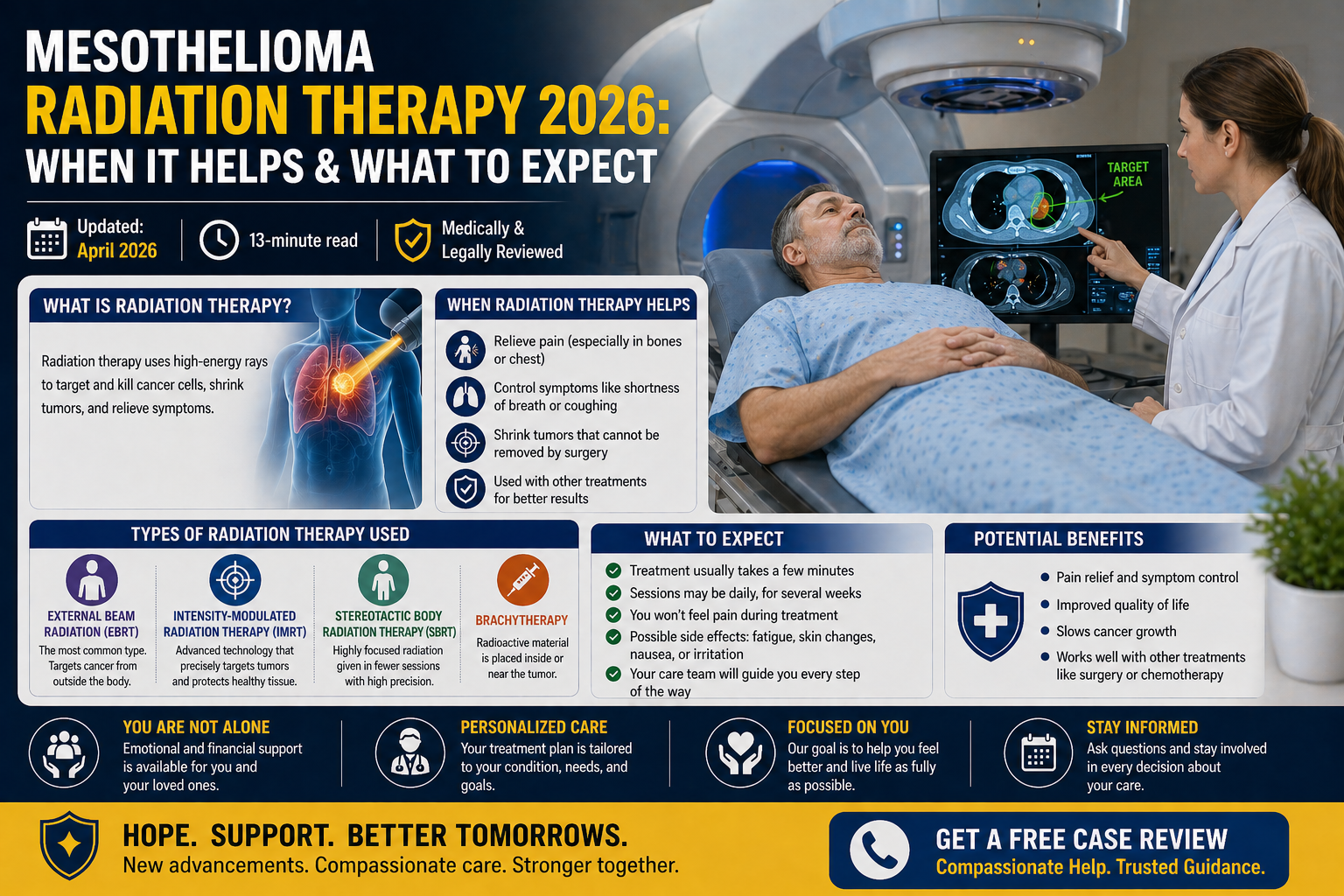
📅 Updated: April 2026 | ⏱ 13-minute read | ✅ Medically & Legally Reviewed
Introduction
Of the four main mesothelioma treatments, surgery, chemotherapy, immunotherapy, and radiation, radiation is the one patients understand least going into their diagnosis. It is also the one most frequently undersold.
Radiation does not cure mesothelioma. Neither does surgery, chemotherapy, or immunotherapy. But radiation therapy can meaningfully extend survival as part of multimodal treatment, nearly double 2-year and 5-year survival rates in certain patient groups, dramatically relieve pain and pressure when used palliatively, and in specific protocols like SMART, Surgery for Mesothelioma After Radiation Therapy, achieve median survival of 51 months in selected patients.
A 2023 study reviewing thousands of pleural mesothelioma cases found that radiation therapy nearly doubled both 2-year and 5-year survival rates. Another expert at Mount Sinai states plainly: “If you’re not a candidate for surgery, radiotherapy can do almost as well as surgery. And the combination of the two is even better, like 40% better.”
This guide covers all of it: what radiation does, every technique available in 2026, when radiation is and isn’t appropriate, side effects and how they’re managed, the SMART protocol’s landmark results, proton therapy’s emerging role, and how radiation treatment costs are covered through legal compensation.
How Radiation Therapy Works Against Mesothelioma
Radiation therapy uses high-energy beams, either X-rays (photons) or protons, to damage the DNA inside mesothelioma cancer cells. When DNA is damaged beyond repair, cancer cells lose the ability to divide and eventually die.
Three key principles make radiation effective for mesothelioma:
1. Cancer cells repair damage less effectively than normal cells
Healthy tissue surrounding a tumor can recover from radiation exposure. Cancer cells, with their disrupted DNA repair mechanisms, generally cannot. This difference is the foundation of radiation’s targeted effectiveness.
2. Precise imaging enables targeted delivery
Modern radiation techniques use CT, PET, and MRI imaging to map tumor locations with millimeter precision. This allows radiation to be concentrated on cancer while sparing the lungs, heart, liver, kidneys, and spinal cord as much as possible.
3. The abscopal effect, radiation’s bonus
In some patients, radiation triggers a rare immune response where treating one tumor causes shrinkage of tumors elsewhere in the body that radiation never directly reached. This “abscopal effect” is especially relevant when radiation is combined with immunotherapy, the immune activation from immunotherapy may amplify this systemic response. Research into intentionally triggering the abscopal effect through radiation + immunotherapy combinations is active in 2026.
When Radiation Is, and Isn’t, Used for Mesothelioma
Understanding when radiation is appropriate requires knowing the distinctions between the three main contexts in which it’s used:
| Context | Purpose | Timing |
|---|---|---|
| Curative/multimodal | Part of a treatment plan aimed at maximum survival | Before or after surgery; combined with chemo |
| Palliative | Symptom relief, pain, pressure, breathlessness | Any stage; particularly advanced disease |
| Prophylactic | Prevent cancer seeding at surgical incision sites | After drainage procedures or biopsy |
Radiation IS typically recommended for:
- Pleural mesothelioma patients in multimodal treatment protocols (surgery + chemo + radiation)
- Patients with localized tumor recurrence after prior treatment
- Patients with pain, chest pressure, or breathing difficulty caused by tumor mass
- Prevention of seeding at biopsy or drainage sites (though evidence on prophylactic radiation has evolved, see below)
- Oligometastatic disease (3–5 distant spread sites amenable to targeted stereotactic radiation)
Radiation is NOT typically recommended for:
- Peritoneal mesothelioma, abdominal organ proximity makes high-dose radiation too dangerous to vital structures
- Pericardial mesothelioma, heart proximity limits safe dose delivery (though exceptional cases have been treated successfully)
- Patients with excessive pleural fluid making tumor targeting inaccurate
- Patients with severely compromised lung, cardiac, or kidney function
Types of Radiation Therapy for Mesothelioma, 2026
1. IMRT, Intensity-Modulated Radiation Therapy
IMRT is the standard, most widely used radiation technique for mesothelioma, and the backbone of virtually every modern mesothelioma radiation protocol.
How it works:
IMRT is an advanced form of external beam radiation. Instead of delivering a fixed-intensity beam, IMRT uses hundreds of small, computer-controlled beam segments that vary in intensity as they arc around the patient’s body. The result is a precisely sculpted dose distribution, high dose to the tumor, rapidly falling off at the edges to protect surrounding structures.
Why IMRT matters for mesothelioma specifically:
Pleural mesothelioma wraps around the lung like a rind, covering a large, irregularly shaped surface area rather than forming a single discrete mass. IMRT’s ability to shape dose to complex geometries makes it the ideal tool for this anatomy.
IMRT effectiveness data:
- One study reported a 14% local recurrence rate with IMRT vs. 42% with conventional radiation, a dramatic improvement in local control
- 2-year survival rates following P/D + IMRT range from 40%–68% across published series
- The IMPRINT Phase II trial confirmed that IMRT can be safely delivered after pleurectomy/decortication (P/D), the lung-sparing surgery now preferred at most centers
07:52
2. IGRT, Image-Guided Radiation Therapy
IGRT adds real-time imaging during each treatment session, not just during initial planning, allowing the radiation team to verify and adjust tumor position before each delivery.
Why it matters: Mesothelioma tumors can shift slightly between sessions due to breathing, organ movement, and tumor changes. IGRT ensures that each fraction of radiation hits the target accurately, even as the body changes over the course of a 4–6 week treatment course.
IGRT is now standard practice at most major radiation oncology centers, often used in combination with IMRT for maximum precision.
3. VMAT, Volumetric Modulated Arc Therapy
VMAT is an advanced evolution of IMRT in which radiation is delivered continuously as the linear accelerator rotates in arcs around the patient. This achieves:
- Shorter treatment times, sessions that previously took 20–30 minutes can be delivered in 5–10 minutes
- Equivalent or superior dose conformality to standard IMRT
- Reduced treatment fatigue for patients who must attend daily sessions over weeks
VMAT is increasingly replacing standard IMRT at centers that have the equipment, delivering the same quality of treatment with less time burden on patients.
4. 3D-CRT, Three-Dimensional Conformal Radiation Therapy
3D-CRT was the predecessor to IMRT. It uses CT imaging to create a three-dimensional tumor map and shapes radiation beams to conform to the tumor’s outline, but without the intensity modulation that makes IMRT more precise.
Current role: 3D-CRT is still used at centers without full IMRT capability and for certain simpler treatment scenarios. For the complex anatomy of mesothelioma, IMRT or VMAT are generally preferred when available.
5. Proton Therapy, The Most Precise External Beam Option
Proton therapy is the most technologically advanced, and most expensive, radiation option for mesothelioma. Instead of X-rays (photons), it uses protons (positively charged particles) that behave fundamentally differently in tissue.
The Bragg Peak advantage:
Photon beams deposit energy throughout their path, entering the body, depositing dose at the tumor, then continuing through to deposit additional dose in healthy tissue on the other side. Protons travel to a precisely calculated depth, deposit most of their energy (the “Bragg Peak”), then stop. There is essentially no exit dose beyond the tumor.
For mesothelioma, where the tumor wraps around one lung and critical structures (heart, liver, opposite lung, spinal cord) are nearby, this physics difference is clinically meaningful:
| Structure | Radiation Dose | Photon IMRT | Proton Therapy |
|---|---|---|---|
| Contralateral (opposite) lung | Should be near-zero | Moderate dose delivered | Near-zero dose achievable |
| Heart | Should be minimized | Some dose inevitable | Significantly lower |
| Liver | Should be minimized | Variable | Dramatically reduced |
| Spinal cord | Should be below tolerance | Managed with planning | Better sparing |
2026 proton therapy data for mesothelioma:
- A 2025 dosimetric study published in International Journal of Radiation Oncology confirmed significantly more favorable organ-at-risk sparing with proton hemithoracic irradiation vs. IMRT
- University of Pennsylvania trial: mesothelioma patients treated with proton therapy achieved a 2-year survival rate of 37%
- The 2026 National Proton Conference highlighted a 10% improvement in 5-year overall survival for patients treated with intensity-modulated proton therapy (IMPT) vs. IMRT across cancer types
Who qualifies for proton therapy:
- Patients with pleural mesothelioma requiring hemithoracic radiation
- Those with compromised lung function where minimizing dose to the contralateral lung is critical
- Younger patients where long-term cardiac and pulmonary toxicity is a concern
- Patients near or following P/D where the remaining lung must be protected
Where proton therapy is available:
Proton therapy requires specialized, expensive facilities, not available at all centers:
- Penn Medicine (Philadelphia, PA)
- MD Anderson Cancer Center (Houston, TX)
- Massachusetts General Hospital (Boston, MA)
- Mayo Clinic (Rochester, MN)
- UF Health Proton Therapy Institute (Jacksonville, FL)
- Northwestern Medicine (Chicago, IL)
6. SBRT, Stereotactic Body Radiation Therapy
SBRT (also called SAbR, Stereotactic Ablative Radiotherapy) delivers very high doses of precisely targeted radiation in a small number of fractions, typically 1 to 5 sessions, rather than the 20–30+ sessions of conventional radiation.
When it’s used for mesothelioma:
- Oligometastatic disease, targeted treatment of 3–5 specific distant spread sites
- Local recurrence, treating specific tumor recurrences after prior multimodal treatment
- Salvage therapy, for patients who have progressed after prior treatments
Survivor spotlight:
Pleural mesothelioma survivor Michael Cole received SAbR/PULSAR (a pulsed version of SBRT) at UT Southwestern in Dallas after standard treatments. He describes the outcome: “My SAbR/PULSAR radiation treatment was a dramatically successful round of treatment for me, and I doubt that I would be here without it.” The combination of targeted radiation and immunotherapy dramatically slowed his tumor growth without eliminating quality of life.
7. IORT, Intraoperative Radiation Therapy
IORT delivers a single high dose of radiation during surgery, while the pleural surface is open and exposed, and before the chest is closed.
Advantages:
- Radiation is delivered directly to the pleural surface with the lung physically moved out of the field
- Healthy tissues can be physically shielded during delivery
- A single session eliminates tumor cells at the margins immediately after resection
Limitations: IORT requires specialized equipment in the operating room and is available only at a handful of high-volume centers. It is not a standalone treatment, it supplements rather than replaces external beam radiation.
The SMART Protocol, Radiation Before Surgery
The most intriguing radiation approach for pleural mesothelioma in 2026 is one that reverses the traditional order: SMART, Surgery for Mesothelioma After Radiation Therapy.
What Is SMART?
SMART delivers high-dose hemithoracic IMRT first, then removes the entire lung and pleural lining (EPP, Extrapleural Pneumonectomy) approximately one week later.
This reversal of the standard sequence is based on a compelling rationale:
- Radiation is delivered to an intact pleural surface, before the lung and tissue planes are disrupted by surgery
- The lung itself absorbs radiation dose during SMART, which is then removed, eliminating the primary organ-at-risk that normally limits how much radiation can be safely delivered
- Higher doses are achievable precisely because the organ most vulnerable to radiation toxicity isn’t going to stay in the body
SMART Survival Data
| SMART Results | Data |
|---|---|
| Median overall survival | 51 months |
| 1-year survival rate | ~80% |
| Protocol completion rate | High in selected patients |
| Best results in | Epithelioid cell type |
Source: Research shows a median survival of 51 months for patients who underwent SMART. A 2020 follow-up of SMART patients found 4 of 5 alive at 1 year, with one patient showing no recurrence at 2.7 years.
SMART context: The 51-month median survival for SMART patients is among the highest published for any pleural mesothelioma treatment protocol, and significantly exceeds the chemotherapy-alone median of 12–14 months, or even standard EPP + adjuvant radiation protocols.
Who qualifies for SMART:
- Good overall health and performance status (ECOG 0–1)
- Adequate lung function, particularly the contralateral (opposite) lung, which will be doing all the breathing after EPP
- Epithelioid cell type (strongest SMART results)
- Tumor confined to one hemithorax
- Evaluation at a center with dedicated SMART experience, this protocol is not widely available
Centers with SMART experience:
- Princess Margaret Cancer Centre (Toronto, Canada, where SMART was pioneered)
- MD Anderson Cancer Center (Houston, TX)
- Mayo Clinic (Rochester, MN)
- Selected other high-volume US centers
Radiation After Surgery, Adjuvant Protocols
For patients who undergo P/D (the lung-sparing surgery now preferred at most major centers), adjuvant radiation targets residual microscopic disease along the pleural surface after surgery.
Key data on P/D + adjuvant radiation:
- 2-year survival rates: 40%–68% across published series
- Recurrence reduction: IMRT after P/D shows 14% recurrence vs. 42% with conventional radiation
- The IMPRINT Phase II trial confirmed that IMRT can be safely delivered after P/D with acceptable toxicity, a key finding supporting lung-sparing surgery as the foundation of modern multimodal protocols
For EPP + adjuvant radiation:
Historically, EPP was followed by hemithoracic radiation because the removed lung no longer needed to be protected. With P/D now preferred, the technical challenge has shifted, IMRT and proton therapy are the tools that make post-P/D radiation feasible by precisely sparing the retained lung.
2-year survival comparison:
| Surgical Approach + Radiation | 2-Year Survival Range |
|---|---|
| P/D + adjuvant radiation | 40%–68% |
| EPP + adjuvant radiation | 18%–57% |
P/D-based multimodal protocols now achieve equal or superior survival outcomes to EPP-based approaches, which, combined with better quality of life (lung retention), explains P/D’s growing preference.
Palliative Radiation, Symptom Relief at Any Stage
Not every mesothelioma patient is a candidate for aggressive multimodal treatment. For those with advanced disease, multiple comorbidities, or a preference for quality-of-life-focused care, palliative radiation is a valuable tool that can meaningfully improve daily experience.
What Palliative Radiation Can Do
| Symptom | Radiation Effect | Success Rate |
|---|---|---|
| Chest/abdominal pain | Shrinks tumor mass causing pressure | 60–80% report relief |
| Shortness of breath | Reduces tumor volume compressing airways | Significant improvement in many |
| Bone metastasis pain | Direct radiation to painful bone lesions | ~80% pain response rate |
| Spinal cord compression | Emergency radiation to preserve neurological function | Most effective within hours of symptoms |
| Obstruction symptoms | Reduces mass effect on airways or vessels | Effective in many cases |
Palliative radiation typically involves fewer, larger fractions, often 5–10 sessions rather than 20–30, prioritizing rapid symptom control with minimal treatment burden.
Prophylactic Radiation, What the Evidence Now Shows
For years, many mesothelioma centers routinely irradiated biopsy and drainage sites to prevent “seeding”, cancer cells spreading along procedure tracts. This practice has been called into question by recent evidence:
- The SMART-PORT trial found no benefit to prophylactic radiation of procedure tracts in mesothelioma
- The SYSTEMS-2 trial similarly found no survival benefit and potential added toxicity
- Current 2026 guidance: Prophylactic radiation of procedure tracts is no longer routinely recommended at most major mesothelioma centers, though some centers continue it in specific circumstances
This is a meaningful change in practice, if a center is still routinely offering prophylactic tract radiation, it may be working from outdated protocols. Ask your radiation oncologist what the current evidence supports.
Radiation Side Effects, The Complete 2026 Guide
Radiation side effects for mesothelioma depend heavily on the technique used, the radiation field, the total dose, and whether the treatment follows surgery.
Common Side Effects
| Side Effect | Cause | Frequency | Management |
|---|---|---|---|
| Fatigue | Body’s energy expenditure repairing radiation damage | Very common (70%+) | Rest planning; pacing; treat underlying anemia |
| Skin irritation / radiation dermatitis | Skin in the treatment field | Common | Gentle moisturizers; avoid sun; medicated creams if severe |
| Esophagitis (difficulty swallowing) | Radiation near the esophagus | Moderate | Soft foods; lidocaine rinse; anti-inflammatory meds |
| Shortness of breath / cough | Lung inflammation (radiation pneumonitis) | Occasional | Corticosteroids; close monitoring |
| Pleural effusion (fluid buildup) | Inflammatory response | Common (~67% of patients) | Drainage if symptomatic; monitoring |
| Nausea | Variable, dose-dependent | Occasional | Anti-nausea medications; dietary adjustments |
| Hair loss | Limited to the radiated area only | Localized | Temporary; regrows after treatment |
| Radiation fibrosis | Lung scarring after high-dose treatment | Late effect (months later) | Pulmonary rehabilitation; supportive care |
Radiation Pneumonitis, The Most Important Side Effect to Watch
Radiation pneumonitis, inflammation of lung tissue, is the most significant acute side effect of thoracic mesothelioma radiation. Symptoms include:
- Dry cough developing 4–12 weeks after radiation ends
- Progressive shortness of breath
- Low-grade fever
- Chest discomfort
Management: Systemic corticosteroids (prednisone) are the primary treatment. Most cases resolve with a 4–6 week steroid course. Untreated, pneumonitis can progress to radiation fibrosis, permanent lung scarring. Early recognition and treatment is critical.
Report any new respiratory symptoms that develop weeks after completing radiation, don’t assume it’s unrelated to treatment.
Mesothelioma Radiation Survival Rates, 2026 Data
| Treatment Approach | Median OS | 2-Year Survival | 5-Year Survival |
|---|---|---|---|
| Radiation alone (palliative) | ~8–12 months | ~25–30% | Low |
| Chemotherapy + radiation | ~14–18 months | ~35–45% | ~10–15% |
| P/D + chemo + radiation (trimodal) | ~20–26 months | 40–68% | 15–25% |
| EPP + chemo + radiation (trimodal) | ~18–22 months | 18–57% | 10–18% |
| SMART (radiation + EPP) | ~51 months | ~80% at 1 year | Highest published |
Sources: 2023 Cancers journal meta-analysis; IMPRINT trial; SMART studies; asbestos.com radiation outcomes review 2025
The headline finding from 2023 data: Radiation therapy as part of multimodal treatment nearly doubled both 2-year and 5-year survival rates compared to no radiation, across thousands of pleural mesothelioma patients. This is not a marginal benefit. It is a meaningful survival extension that every eligible patient deserves to discuss with their care team.
Who Is Eligible for Mesothelioma Radiation?
| Eligibility Factor | Favorable | Less Favorable |
|---|---|---|
| Mesothelioma type | Pleural (most radiation protocols) | Peritoneal (organ proximity limits dose) |
| Cell type | Epithelioid | Sarcomatoid |
| Performance status | ECOG 0–2 | ECOG 3–4 |
| Lung function | Adequate FEV1 and DLCO | Severely compromised |
| Cardiac function | Normal | Significant heart disease |
| Fluid buildup | Minimal/controlled | Extensive uncontrolled effusion |
| Stage | Any, goals differ by stage | No absolute exclusion by stage |
| Treatment goal | Curative multimodal OR palliative | , |
Critical point: Eligibility for palliative radiation is much broader than eligibility for curative multimodal radiation. Even patients with advanced disease, poorer performance status, or significant comorbidities can benefit from palliative radiation for symptom control, where the risk-benefit balance is different from aggressive treatment.
The Radiation Treatment Process, What to Expect
Before Treatment Begins
Radiation Planning CT (Simulation):
Before any radiation is delivered, you attend a simulation appointment, a dedicated CT scan taken in the exact position you’ll be treated in. Custom immobilization devices (foam molds, masks) are made to ensure you’re positioned identically every session.
Contouring:
Your radiation oncologist uses the simulation CT (often fused with PET and MRI images) to precisely map the tumor volume to be treated and the organs to avoid. For mesothelioma, this is complex, the pleural surface requires detailed contouring.
Treatment Planning:
A medical physicist designs the radiation plan, calculating beam angles, intensities, and total doses to maximize tumor coverage while keeping organ doses within safe limits. For IMRT and proton therapy, this is a multi-day computational process.
Plan Review and Approval:
The final plan is reviewed by the entire radiation oncology team before treatment begins.
During Treatment
| Factor | Details |
|---|---|
| Session frequency | Usually 5 days/week (Monday–Friday) |
| Session duration | 10–30 minutes in the treatment room; 5–10 minutes of actual radiation |
| What you feel | Nothing, radiation is completely painless during delivery |
| Total course length | 4–6 weeks for definitive treatment; 1–2 weeks for palliative |
| Number of fractions | 20–30 for curative; 5–10 for palliative; 1–5 for SBRT |
| Monitoring | Weekly on-treatment visits with your radiation oncologist |
You do not feel radiation during delivery. The most common experience is lying still in a specific position while the machine moves around you. Side effects develop gradually over the course of treatment and in the weeks afterward, not during sessions themselves.
After Treatment
- Skin and fatigue side effects typically peak 1–2 weeks after completion, then gradually improve
- Radiation pneumonitis can develop 4–12 weeks after completion, report new respiratory symptoms promptly
- Follow-up imaging (CT or PET-CT) at 6–8 weeks post-treatment assesses response
- Coordination with your medical oncologist for next-phase treatment (adjuvant chemotherapy, immunotherapy, or maintenance)
Radiation and Your Legal Compensation Rights
Radiation therapy, from initial planning through a 6-week treatment course and follow-up, carries significant documented medical costs:
| Service | Approximate Cost |
|---|---|
| Radiation planning CT + simulation | $2,000–$5,000 |
| IMRT (full course, 25 fractions) | $50,000–$80,000 |
| VMAT (full course) | $50,000–$80,000 |
| Proton therapy (full course) | $100,000–$180,000 |
| SBRT (5 fractions) | $25,000–$50,000 |
| Weekly monitoring visits | $500–$1,500 per visit |
Every one of these costs is fully compensable in your asbestos lawsuit, recovered from the manufacturers responsible for your mesothelioma.
Radiation does not affect your legal rights. The choice to pursue radiation, and the costs of doing so, strengthen your documented economic damages rather than diminishing them in any way.
| Compensation Source | Amount |
|---|---|
| Lawsuit Settlement | $1M – $1.4M average |
| Trial Verdict | $5M – $11.4M average |
| Asbestos Trust Funds | $300K – $400K combined |
| VA Benefits (veterans) | $4,158+/month |
| Combined Total | $1.5M – $2M+ |
Frequently Asked Questions
Does radiation therapy cure mesothelioma?
Radiation does not cure mesothelioma, but it significantly extends survival when used as part of multimodal treatment, and provides meaningful symptom relief when used palliatively. The SMART protocol has achieved median survival of 51 months in selected patients, one of the best published outcomes for any mesothelioma treatment approach.
What is the best type of radiation for mesothelioma in 2026?
IMRT (Intensity-Modulated Radiation Therapy) is the most widely used and well-supported technique. Proton therapy offers superior sparing of healthy tissue and is preferred when available for patients requiring hemithoracic radiation. VMAT delivers equivalent results to IMRT with shorter treatment times.
Can I have radiation if I’ve already had surgery?
Yes, adjuvant (post-surgical) radiation is a standard component of multimodal treatment for pleural mesothelioma. The IMPRINT trial confirmed that IMRT is safe and feasible after P/D (lung-sparing surgery). Radiation after surgery reduces local recurrence and improves survival.
What is the SMART protocol and who qualifies?
SMART delivers high-dose IMRT before EPP surgery, reversing the traditional order. Published data shows median survival of 51 months. Ideal candidates have epithelioid mesothelioma, good lung and cardiac function, and disease confined to one hemithorax. SMART is available at a limited number of specialist centers.
How long does mesothelioma radiation therapy last?
A full curative/multimodal course typically runs 4–6 weeks, delivered 5 days per week. Palliative radiation for symptom control is much shorter, often 1–2 weeks or as few as 5 sessions. SBRT/SAbR protocols deliver treatment in 1–5 sessions.
Does radiation cause hair loss?
Only in the area being treated. Unlike chemotherapy which can cause diffuse hair loss throughout the body, radiation causes hair loss only within the specific treatment field, and it typically regrows after treatment ends.
Can I receive radiation and immunotherapy at the same time?
Yes, and this combination is an active area of clinical research. Radiation may enhance the immune response to immunotherapy, and can trigger the abscopal effect, where treating one tumor causes immune-mediated shrinkage of distant tumors. Several active trials are investigating radiation + immunotherapy combinations specifically for mesothelioma.
Does my choice of radiation treatment affect my legal case?
Not at all. Your legal rights are completely independent of your treatment choices. The costs of radiation, which can exceed $100,000 for proton therapy, are documented economic damages that your attorney recovers from asbestos manufacturers. Pursue the best treatment for your case; your legal claim runs alongside it.
Radiation Is More Than a Support Role, In the Right Protocol, It’s Central
The narrative that radiation is merely a supporting player in mesothelioma treatment, used to clean up after surgery or ease symptoms at end of life, is outdated. The SMART protocol’s 51-month median survival, the evidence that radiation nearly doubles long-term survival in multimodal protocols, and the emergence of proton therapy that makes high-dose hemithoracic treatment safer than ever before, all of this reframes radiation as a central therapeutic tool, not an afterthought.
The question is whether the right patients are getting access to the right radiation protocols at the right centers. Not every radiation oncology department has SMART experience. Not every hospital has proton therapy. Not every mesothelioma patient is told that their case should be reviewed by a multidisciplinary team that includes a radiation oncologist.
Pursue your treatment options aggressively. And pursue your legal compensation aggressively alongside it, they are not in conflict, and you are entitled to both.
👉 Mesothelioma Immunotherapy 2026: Opdivo, Keytruda & Latest Breakthroughs
About the Author
Brian Watson is a senior research editor at MesotheliomaLegalHelp.info with over eight years of experience covering legal and medical topics for digital health publications. He specializes in asbestos litigation, occupational disease, veterans’ benefits, and mesothelioma treatment research. Brian’s work is reviewed against current medical literature, legal precedent, and publicly available case data before publication. He holds a degree in journalism with a concentration in health and science writing.