
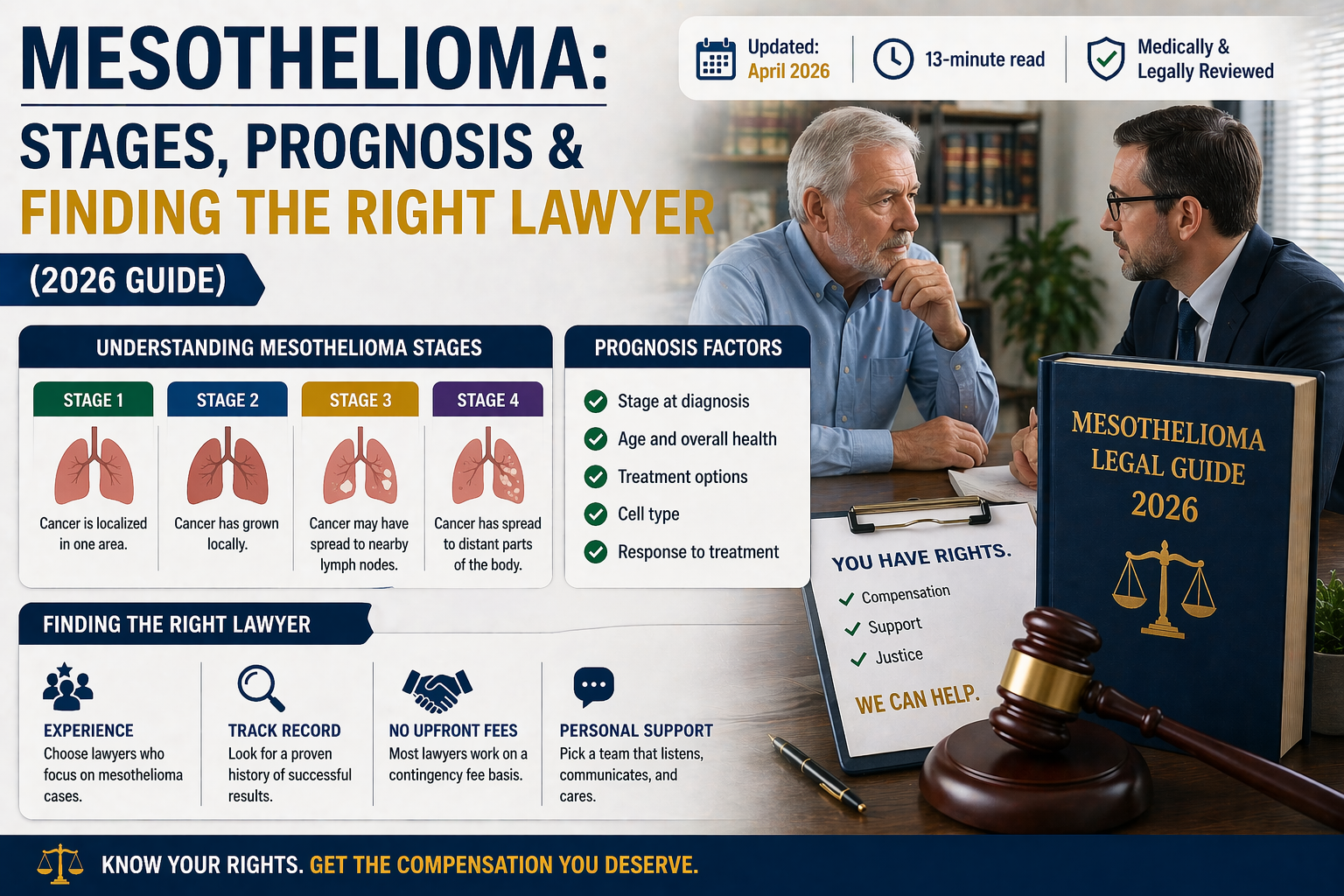
📅 Updated: April 2026 | ⏱ 13-minute read | ✅ Medically & Legally Reviewed
Introduction
Mesothelioma is one of the most aggressive cancers caused by asbestos exposure. It is a disease that develops slowly, often taking 20 to 50 years after exposure to appear, but once it does, it moves fast.
If you or a loved one has been diagnosed, the questions that follow are urgent: How serious is this? What stage is it? What are the chances of survival? What happens if treatment doesn’t work? And is there financial help available, a mesothelioma law firm or local attorney who can help the family?
This guide answers all of those questions honestly and clearly. We cover the early stages of mesothelioma, what happens at Stage 4, the mesothelioma death rate and death process, and how to find mesothelioma lawyers near you who specialize in getting families the compensation they deserve.
What Is Mesothelioma?
Mesothelioma is a rare, aggressive cancer that develops in the mesothelium, the thin protective lining that covers the lungs, abdomen, and heart. It is caused almost exclusively by exposure to asbestos fibers, which embed in the lining of these organs and, over decades, trigger malignant cell growth.
There are four main types:
| Type | Location | % of Cases |
|---|---|---|
| Pleural | Lining of the lungs | ~75% |
| Peritoneal | Lining of the abdomen | ~20% |
| Pericardial | Lining of the heart | ~1–2% |
| Testicular | Lining of the testes | <1% |
Pleural mesothelioma is by far the most common, and the type most people mean when they simply say “mesothelioma.” It is also the type most frequently associated with asbestos exposure in the workplace, military service, and construction.
Mesothelioma is not lung cancer, though it affects the same region of the body and is often mistaken for it. The two diseases differ in origin, cell structure, treatment, and prognosis. A correct diagnosis from a specialist is essential.
Mesothelioma Death Rate, 2026 Statistics
The mesothelioma death rate is one of the most sobering facts about this disease:
- Approximately 2,500–3,000 Americans die from mesothelioma each year
- 5-year overall survival rate: approximately 10% (all stages combined)
- Median survival: 12–21 months from diagnosis (varies by stage and cell type)
- 1-year survival rate: approximately 55–60%
- 2-year survival rate: approximately 30–35%
Source: NCI SEER Database, American Cancer Society, 2026
These numbers are sobering, but they are averages across all patients, all stages, and all treatment approaches. Patients who are diagnosed early, receive specialist care, and undergo multimodal treatment consistently achieve survival times far above the median.
Mesothelioma death rate by cell type:
| Cell Type | Median Survival | 5-Year Survival |
|---|---|---|
| Epithelioid | 12–24+ months | 10–15% |
| Biphasic | 10–18 months | 5–10% |
| Sarcomatoid | 6–12 months | 1–5% |
The emergence of FDA-approved immunotherapy (nivolumab + ipilimumab) in 2020 has begun to shift these numbers upward, particularly for non-epithelioid patients who previously had almost no effective treatment options.
Mesothelioma Early Stages, Stages 1 & 2
One of the most important things to understand about mesothelioma is that the early stages rarely produce obvious symptoms. This is why the disease is so often diagnosed late, and why anyone with a history of asbestos exposure should communicate that clearly to their doctor.
Stage 1, Localized Disease
At Stage 1, mesothelioma is confined to one side of the pleural lining. There is no lymph node involvement and no distant spread.
Symptoms at Stage 1:
- Mild shortness of breath
- Slight chest discomfort or tightness
- Occasional dry cough
- Mild fatigue, often dismissed as aging or routine illness
Most Stage 1 patients feel well enough that symptoms are easy to ignore or explain away. This is why diagnosis at Stage 1 is rare, only about 5–10% of mesothelioma patients are diagnosed this early.
Treatment options at Stage 1:
- Surgery (P/D or EPP), the best window for potentially curative intervention
- Chemotherapy (before or after surgery)
- Radiation therapy (as part of multimodal treatment)
- Clinical trials
Median survival at Stage 1: ~22.2 months. With aggressive multimodal treatment at a specialist center, some patients significantly exceed this.
Stage 2, Limited Spread
At Stage 2, the tumor has begun to spread to nearby structures, possibly the lung, diaphragm, or surrounding tissue, but remains localized to one side of the chest without significant lymph node involvement.
Symptoms at Stage 2:
- More persistent shortness of breath
- Dull chest pain
- Chronic dry cough
- Low-grade fever
- Mild weight loss
- Fatigue that interferes with daily activity
Diagnosis at Stage 2 still allows for surgical intervention in many cases, though the window is narrowing.
Median survival at Stage 2: ~20 months.
Mesothelioma Later Stages, Stages 3 & 4
Stage 3, Regional Spread
At Stage 3, mesothelioma has spread beyond the original site to involve regional lymph nodes and possibly the chest wall, mediastinum, or other nearby organs. Surgery is rarely an option at this stage.
Symptoms at Stage 3:
- Significant shortness of breath, often requiring oxygen
- Persistent, severe chest or abdominal pain
- Pleural effusion (fluid around the lungs) causing breathing difficulty
- Noticeable weight loss
- Difficulty swallowing
- Night sweats
- Swelling in the face or arms
Treatment options at Stage 3:
- Chemotherapy (pemetrexed + cisplatin or carboplatin)
- Immunotherapy (nivolumab + ipilimumab)
- Palliative procedures (thoracentesis to drain fluid)
- Radiation for pain control
- Clinical trials
Median survival at Stage 3: ~17.9 months.
Stage 4 Mesothelioma, Prognosis & What to Expect
Stage 4 is the most advanced stage of mesothelioma. At this point, the cancer has spread to distant organs, including the opposite lung, liver, kidneys, brain, or bone, and treatment is focused on extending life and maintaining quality of life rather than attempting a cure.
Stage 4 mesothelioma prognosis:
| Metric | Stage 4 Pleural Mesothelioma |
|---|---|
| Median survival | ~14.9 months |
| 1-year survival rate | ~36.9% |
| 2-year survival rate | ~26% |
| 5-year survival rate | ~4–5% |
Source: NCI SEER Database; LungCancerGroup.com, 2026
Stage 4 mesothelioma without treatment:
For patients who choose not to pursue treatment, or who are not medically eligible, median survival drops significantly. Without any active treatment, Stage 4 pleural mesothelioma typically carries a survival of 4 to 12 months from diagnosis, depending on overall health, cell type, and the extent of organ involvement.
Palliative care, focused on pain management, breathing support, and quality of life, is still strongly recommended even when curative treatment is not pursued. Hospice care is an important option at this stage, providing comfort and dignity for both patients and families.
Treatment options at Stage 4:
- Immunotherapy (nivolumab + ipilimumab), can meaningfully extend survival even at this stage
- Chemotherapy (palliative intent)
- Pleural or peritoneal drainage for symptom relief
- Radiation for pain or localized tumor control
- Clinical trials, important to explore, as many trials are open to Stage 4 patients
- Palliative and hospice care
Even at Stage 4, some patients respond remarkably to immunotherapy. The CheckMate 743 trial included patients at all stages, and the 3-year survival rate of 23% means that roughly 1 in 4 patients receiving nivolumab + ipilimumab was still alive three years after starting treatment. Individual responses vary significantly.
The Mesothelioma Death Process, What Families Should Know
This is a difficult topic, but it’s one that families often need honest information about as they prepare for what lies ahead.
Mesothelioma end-of-life typically follows a recognizable progression, though the timing and experience differ for every patient.
Early end-of-life signs (weeks to months before death):
- Significant weight loss and muscle wasting
- Increasing fatigue and weakness
- Loss of appetite, sometimes complete
- Growing need for supplemental oxygen
- Increased pain, managed with medication
- Cognitive changes, confusion or difficulty concentrating
Later signs (days to weeks before death):
- Extended periods of sleep and unconsciousness
- Decreased urination and fluid intake
- Labored or irregular breathing (Cheyne-Stokes pattern)
- Mottling of the skin, a bluish-purple discoloration in hands, feet, and knees
- Cooling of the extremities
- Reduced or absent response to surroundings
In the final hours:
- Breathing becomes very shallow and intermittent
- “Death rattle”, a distinctive sound caused by mucus in the airway as breathing reflexes weaken
- Gradual, peaceful loss of consciousness in most cases
The mesothelioma death process is generally not marked by sudden pain or crisis. With proper palliative care and hospice support, most patients pass peacefully and without distress. Hospice teams are experienced in managing every symptom and can keep patients comfortable throughout.
For families: This process can be deeply difficult to witness. Hospice nurses and social workers are trained to support both the patient and their loved ones through every stage. Do not hesitate to ask for help.
Read More:
Mesothelioma Diagnosis: First Steps, Treatment Options & Legal Rights 2026
Mesothelioma Lung Cancer, Understanding the Difference
Mesothelioma and asbestos-related lung cancer are two distinct diseases, but both are caused by asbestos exposure, and both entitle victims to significant legal compensation.
| Mesothelioma | Asbestos Lung Cancer | |
|---|---|---|
| Origin | Mesothelial lining (pleura, peritoneum) | Lung tissue itself |
| Cause | Asbestos exposure (primary cause) | Asbestos + often smoking |
| Common cell type | Epithelioid, sarcomatoid, biphasic | Adenocarcinoma, squamous cell |
| Diagnosis | Often Stage 3–4 at detection | Various stages |
| 5-year survival | ~10% all stages | ~25% all stages |
| Legal rights | Full rights to sue + trust funds | Full rights to sue + trust funds |
| VA benefits | Available for veterans | Available for veterans |
If you or a loved one has been diagnosed with asbestos-related lung cancer, not mesothelioma, you have the same legal rights and access to the same compensation sources. Many families don’t realize this. A mesothelioma law firm handles both types of cases.
Finding Mesothelioma Lawyers Near Me, What You Need to Know
One of the most searched questions after a mesothelioma diagnosis is: “mesothelioma lawyers near me.” Here’s the most important thing to know first:
Location doesn’t limit your options. The best mesothelioma law firms in the United States serve clients in all 50 states and handle everything remotely or with in-home visits. You do not need to find a lawyer in your city, you need to find a specialist in mesothelioma law, wherever they are based.
That said, here’s how to find the right attorney:
What Makes a True Mesothelioma Law Firm
Not every personal injury lawyer should handle mesothelioma cases. Look for these specific qualities:
✅ Mesothelioma-exclusive practice
The firm handles asbestos and mesothelioma cases as their primary or exclusive focus, not a general practice that occasionally takes these cases.
✅ Access to asbestos product databases
Top mesothelioma law firms maintain proprietary databases of thousands of asbestos-containing products, manufacturers, and job sites. This is how they identify defendants, and additional compensation, that general attorneys miss.
✅ Documented track record
Look for publicly reported verdicts and settlements in the millions. The best firms have recovered billions collectively.
✅ Serves your state
Confirm the firm is licensed to practice in your state or works with local co-counsel. Most national firms handle all 50 states.
✅ 100% contingency fee
No upfront cost, ever. Fees come from your settlement only if you win. If any attorney asks for money upfront, walk away.
✅ Free in-home consultation
After a mesothelioma diagnosis, you shouldn’t have to travel. Every reputable firm comes to you.
Top National Mesothelioma Law Firms, 2026
| Law Firm | Total Recovered | Notable Strength |
|---|---|---|
| Weitz & Luxenberg | $13 Billion+ | Largest asbestos recovery in US history |
| Simmons Hanly Conroy | $10.3 Billion+ | Nationwide, Tier 1 rated |
| Cooney & Conway | $7 Billion+ | 40+ years asbestos experience |
| Ferraro Law | $2 Billion+ | Top 100 National Trial Lawyers |
| The Nemeroff Law Firm | $650 Million+ | “Hall of Fame”, The Legal 500 |
| Galiher DeRobertis & Waxman | $600 Million+ | 30+ years, nationwide reach |
| Meirowitz & Wasserberg | $200 Million+ | Top 10 asbestos trial lawyers |
All of these firms serve clients nationwide and handle cases remotely.
Questions to Ask When Contacting a Mesothelioma Law Firm
When you call or submit a case evaluation request, ask:
- What percentage of your practice is mesothelioma and asbestos cases?
- How many trust fund claims do you typically identify in a case like mine?
- Will you pursue trust funds and my lawsuit simultaneously?
- What is your contingency fee percentage?
- Will I ever need to appear in court?
- Can you come to my home for the consultation?
A specialist will answer every one of these confidently and clearly.
How Much Compensation Can a Mesothelioma Law Firm Get You?
| Source | Typical Amount |
|---|---|
| Personal Injury Lawsuit Settlement | $1M – $1.4M average |
| Trial Verdict | $5M – $11.4M average |
| Asbestos Trust Funds (60+ active) | $300K – $400K combined |
| VA Benefits (veterans) | $4,000+/month |
| Typical Combined Total | $1.5M – $2M+ |
This compensation is available regardless of stage. Even Stage 4 patients, and their families, are entitled to full legal compensation. The severity of the disease often increases the damages awarded, not the other way around.
Statute of Limitations, Why You Cannot Wait
Every state has a strict deadline for filing mesothelioma claims, typically 1 to 3 years from diagnosis for personal injury claims, and from the date of death for wrongful death claims.
Missing this deadline permanently ends your right to compensation.
If a Stage 4 diagnosis has been received, time is especially critical. Many families lose their right to sue simply by waiting too long to contact a mesothelioma law firm. A free consultation, which costs nothing and commits you to nothing, confirms your deadline immediately.
Frequently Asked Questions
What is the mesothelioma death rate?
Approximately 2,500–3,000 Americans die from mesothelioma annually. The overall 5-year survival rate is approximately 10%. Survival varies significantly by stage, cell type, and treatment, patients diagnosed early and treated at specialist centers consistently achieve better outcomes than population averages suggest.
What is Stage 4 mesothelioma prognosis?
Median survival for Stage 4 pleural mesothelioma is approximately 14.9 months. The 5-year survival rate is 4–5%. However, immunotherapy (nivolumab + ipilimumab) has meaningfully extended survival for some Stage 4 patients, and clinical trials continue to push these numbers forward.
What is Stage 4 mesothelioma without treatment?
Without treatment, Stage 4 mesothelioma typically results in survival of 4 to 12 months. Palliative and hospice care significantly improves quality of life even when curative treatment is not pursued.
What are the early signs of mesothelioma?
Early-stage mesothelioma symptoms are often mild and easy to overlook, slight shortness of breath, mild chest discomfort, occasional dry cough, and fatigue. Anyone with a history of asbestos exposure who experiences these symptoms should request imaging and inform their doctor of their exposure history immediately.
What is the difference between mesothelioma and lung cancer?
Both can be caused by asbestos, but they originate in different tissues. Mesothelioma forms in the protective lining around organs; asbestos lung cancer develops in the lung tissue itself. Both conditions entitle victims to legal compensation through lawsuits and trust funds.
How do I find mesothelioma lawyers near me?
Location matters less than specialization. The best mesothelioma law firms serve all 50 states and offer free in-home consultations, you don’t need a local attorney, you need a mesothelioma specialist. Use the free case evaluation on this site to be connected with a qualified firm.
Can my family file a claim after I pass away?
Yes. Surviving spouses, children, and estate representatives can file wrongful death claims after a loved one dies from mesothelioma. These claims follow the same compensation structure, lawsuits, trust funds, and VA benefits (for veterans), and average $1 million to $7 million.
Take the First Step, It Costs Nothing
Whether you’re in the early stages of mesothelioma, facing a Stage 4 diagnosis, or have recently lost a loved one, your legal rights are the same. Compensation is available from multiple sources, and pursuing it costs nothing upfront.
The firms connected through this site:
- Handle mesothelioma cases exclusively
- Come to you, no travel required
- Serve clients in all 50 states
- Work on 100% contingency, zero upfront cost
- Pursue lawsuits, trust funds, and VA benefits simultaneously
⏰ Statutes of limitations are strict. Don’t wait.
👉 Asbestos Trust Funds 2026: How to File a Claim & How Much You Can Get