
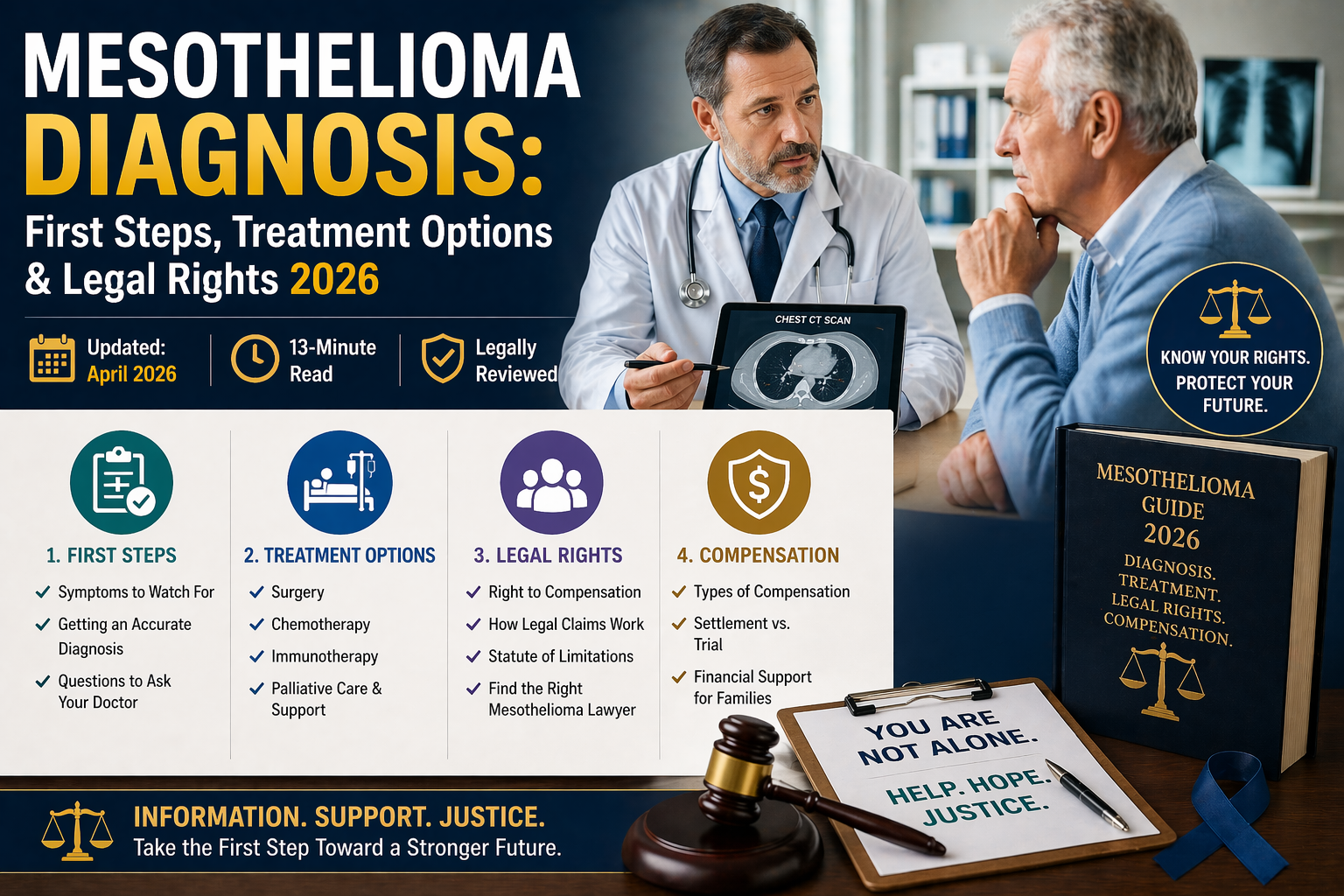
📅 Updated: April 2026 | ⏱ 15-minute read | ✅ Medically & Legally Reviewed
Introduction
A mesothelioma diagnosis changes everything, in an instant. The questions flood in before you’ve even left the doctor’s office. What does this mean for my future? What treatment options do I have? How do we afford this? Do we have legal rights?
This guide answers all of those questions in one place, clearly, honestly, and without jargon.
The good news: mesothelioma treatment has advanced significantly. The FDA-approved immunotherapy combination of nivolumab and ipilimumab, approved in 2020 after a landmark clinical trial, is extending survival beyond what chemotherapy alone could achieve. Clinical trials in 2026 are pushing the boundaries further. And for most families, significant financial compensation is available, from lawsuits, trust funds, and VA benefits, to help cover the cost of care.
Here’s everything you need to know about what comes next.
Step 1: Understand How Mesothelioma Is Diagnosed
Before any treatment decisions are made, a confirmed, accurate diagnosis is essential. Mesothelioma is frequently misdiagnosed, up to 50% of cases are initially mistaken for pneumonia, COPD, or irritable bowel syndrome because the symptoms overlap with many more common conditions.
Getting the diagnosis right from the start affects every treatment decision that follows.
How the Diagnostic Process Works
Stage 1, Imaging Tests
Diagnosis almost always begins with imaging. Your doctor is looking for fluid buildup, pleural thickening, and tumor locations:
| Test | What It Shows |
|---|---|
| Chest X-ray | First clue, may reveal pleural effusion (fluid around the lungs) |
| CT Scan | Primary imaging tool, shows tumor location, size, and spread |
| PET Scan | Detects metabolically active cancer cells; shows if disease has spread |
| MRI | Superior soft-tissue detail; essential for surgical planning |
Stage 2, Blood Biomarker Tests
Blood tests alone cannot confirm mesothelioma, but they support the diagnosis and help monitor treatment response:
- SMRP (Soluble Mesothelin-Related Peptides), The FDA-approved MESOMARK assay; elevated in approximately 84% of epithelioid mesothelioma patients
- Fibulin-3, Emerging biomarker that helps distinguish mesothelioma from other pleural diseases
- Osteopontin, Elevated levels may indicate mesothelioma, though less specific than SMRP
Stage 3, Tissue Biopsy (The Critical Step)
A biopsy is the only way to definitively confirm a mesothelioma diagnosis. It also identifies the cell type, which directly determines treatment options and expected outcomes.
Biopsy methods include:
- Thoracoscopy (VATS), Minimally invasive camera-guided procedure; most common for pleural mesothelioma
- Laparoscopy, The equivalent procedure for peritoneal mesothelioma
- CT-guided needle biopsy, Less invasive but may yield insufficient tissue in some cases
- Open surgical biopsy, Used when less invasive methods don’t provide enough tissue
Why cell type matters so much: Immunohistochemistry (IHC) staining during biopsy analysis identifies whether your mesothelioma is epithelioid, sarcomatoid, or biphasic. This single result has a greater impact on your treatment plan and prognosis than almost any other factor. Always ensure your biopsy is reviewed by a pathologist with specific mesothelioma experience.
Step 2: Understand Your Mesothelioma Cell Type
| Cell Type | % of Cases | Treatment Response | Prognosis |
|---|---|---|---|
| Epithelioid | 50–70% | Most responsive to surgery and chemotherapy | Best, median survival 12–24+ months |
| Sarcomatoid | 10–20% | Least responsive to conventional treatment | Worst, median survival 6–12 months |
| Biphasic | 20–30% | Depends on dominant cell ratio | Intermediate, median survival 10–18 months |
Important 2026 development: Immunotherapy (nivolumab + ipilimumab) has shown the most dramatic benefit in non-epithelioid (sarcomatoid and biphasic) cases, historically the hardest to treat. In the CheckMate 743 trial, patients with non-epithelioid mesothelioma saw median survival nearly double: 18.1 months vs. 8.8 months with chemotherapy. This is one of the most significant treatment advances in the history of this disease.
Step 3: Get Staged, What Your Stage Means for Treatment
Mesothelioma is staged using the TNM system (Tumor, Lymph Nodes, Metastasis) from Stage 1 through 4. Your stage determines which treatment options are available and what outcomes you can realistically expect.
| Stage | What It Means | Treatment Options | Median Survival |
|---|---|---|---|
| Stage 1 | Localized to pleural lining, no lymph node involvement | Surgery (EPP or P/D), chemo, radiation, multimodal | ~22.2 months |
| Stage 2 | Spread to adjacent structures (lung, diaphragm) | Surgery, chemotherapy, radiation, multimodal | ~20 months |
| Stage 3 | Locally advanced; regional lymph node involvement | Chemotherapy, immunotherapy, palliative surgery | ~17.9 months |
| Stage 4 | Distant metastasis | Chemotherapy, immunotherapy, palliative care, clinical trials | ~14.9 months |
Source: NCI SEER Database, 2026. Individual outcomes vary based on cell type, treatment, and overall health.
For peritoneal mesothelioma: Staging uses a different system, the Peritoneal Cancer Index (PCI). Patients with lower PCI scores are better candidates for cytoreductive surgery with HIPEC, which has achieved 5-year survival rates of 41–59%, remarkable numbers for a disease once considered universally fatal within a year.
Step 4: Understand Your Treatment Options in 2026
Treatment depends on your stage, cell type, location (pleural vs. peritoneal), and overall health. The most effective approach for eligible patients is multimodal treatment, combining two or more therapies simultaneously.
Surgery
Surgery offers the best chance of long-term survival for eligible patients with Stage 1–2 disease and epithelioid or predominantly epithelioid cell type.
The two main surgical options for pleural mesothelioma:
| EPP (Extrapleural Pneumonectomy) | P/D (Pleurectomy/Decortication) | |
|---|---|---|
| What’s removed | Lung, pleura, diaphragm, pericardium | Pleural lining and visible tumors, lung preserved |
| Ideal for | Younger patients, early-stage, strong lung function | Broader candidate pool |
| Surgical mortality | ~5–7% | ~1–4% |
| Median survival | 12–22 months (with multimodal) | 16–31 months (with multimodal) |
P/D has become the preferred option at most leading mesothelioma centers due to lower mortality, faster recovery, and comparable long-term survival.
For peritoneal mesothelioma: Cytoreductive surgery (CRS) combined with HIPEC (heated intraperitoneal chemotherapy) is the standard surgical approach. This involves removing all visible tumors from the abdominal cavity, then bathing the area in heated chemotherapy during surgery. Results are remarkable, 5-year survival exceeds 50% in optimal candidates with epithelioid cell type.
Chemotherapy
Chemotherapy remains a cornerstone of treatment at every stage:
- First-line standard: Pemetrexed (Alimta) + cisplatin, the gold standard since 2004
- Alternative: Pemetrexed + carboplatin, for patients who can’t tolerate cisplatin; similar efficacy
- Second-line: Gemcitabine or vinorelbine for patients who have progressed on first-line treatment
- Neoadjuvant (before surgery): Shrinks tumors to improve surgical outcomes
- Adjuvant (after surgery): Eliminates residual microscopic disease
Immunotherapy, The Biggest Treatment Advance in 16 Years
This is the treatment development every mesothelioma patient needs to know about in 2026.
Nivolumab + Ipilimumab (Opdivo + Yervoy)
In October 2020, the FDA approved this combination as first-line treatment for unresectable pleural mesothelioma, the first new approved treatment in 16 years. The approval was based on the landmark CheckMate 743 trial, which enrolled 605 patients and produced results that changed clinical practice worldwide.
Key CheckMate 743 Results:
| Metric | Nivolumab + Ipilimumab | Chemotherapy |
|---|---|---|
| Median Overall Survival | 18.1 months | 14.1 months |
| 2-Year Survival Rate | 41% | 27% |
| 3-Year Survival Rate | 23.2% | 15.4% |
| Median Duration of Response | 11.0 months | 6.7 months |
| Non-Epithelioid Median OS | 18.1 months | 8.8 months |
Source: Baas P. et al., The Lancet, 2021; updated ASCO 2022, WCLC 2023
The most striking finding: in sarcomatoid and biphasic cases, the most aggressive, hardest-to-treat cell types, immunotherapy reduced the risk of death by 54% compared to chemotherapy. A hazard ratio of 0.46 is one of the most significant treatment effects ever seen in a mesothelioma clinical trial.
Patients who respond to immunotherapy also tend to stay in remission longer, median response duration of 11 months vs. 6.7 months with chemo. That durability matters enormously for quality of life.
Who qualifies? Adults with unresectable pleural mesothelioma who have not received prior systemic therapy, with ECOG performance status 0–1, and no active autoimmune conditions.
Radiation Therapy
Radiation plays an important supporting role in multimodal treatment:
- IMRT (Intensity-Modulated Radiation Therapy), Precisely targets tumors after surgery while protecting surrounding tissue
- Palliative radiation, Relieves pain and reduces tumor burden when curative treatment isn’t feasible
- Prophylactic radiation, Applied to biopsy or surgical incision sites to prevent tumor seeding
- Proton therapy, More precise than traditional radiation; available at specialized centers and under active study
Multimodal Treatment, The Gold Standard
The best outcomes consistently come from combining treatments:
| Combination | Best For |
|---|---|
| Surgery + Chemo + Radiation | Stage 1–2 pleural, epithelioid cell type |
| CRS + HIPEC | Peritoneal mesothelioma |
| Immunotherapy + Chemo | Unresectable disease, all cell types |
| Immunotherapy alone | Unresectable, especially non-epithelioid |
Step 5: Get a Second Opinion From a Mesothelioma Specialist
This is not optional, it’s essential.
Mesothelioma is rare. Fewer than 3,000 Americans are diagnosed each year. Most community oncologists will see only a handful of cases in their entire career. A mesothelioma specialist sees hundreds. The difference in outcome is documented and significant.
What a mesothelioma specialist offers that a general oncologist typically cannot:
- Experience with the full range of surgical options (EPP vs. P/D)
- Access to clinical trials not available at general hospitals
- Multidisciplinary tumor boards dedicated to mesothelioma
- Specific expertise in reading mesothelioma pathology reports
- Knowledge of the latest immunotherapy protocols and eligibility criteria
Where to find mesothelioma specialists:
Leading mesothelioma treatment centers include:
- MD Anderson Cancer Center (Houston, TX)
- Memorial Sloan Kettering Cancer Center (New York, NY)
- Brigham and Women’s Hospital (Boston, MA)
- University of Chicago Medicine
- Penn Medicine (Philadelphia, PA)
- Cedars-Sinai Medical Center (Los Angeles, CA)
Most of these centers offer remote consultations. You don’t need to travel to get a world-class second opinion.
Step 6: Explore Clinical Trials in 2026
Clinical trials give patients access to the most cutting-edge treatments before they’re widely available. For patients at any stage, especially those who have exhausted standard options, a clinical trial can open doors that didn’t previously exist.
Promising areas under active investigation in 2026:
- Tumor Treating Fields (TTFields), The STELLAR trial showed 18.2-month median survival when combined with pemetrexed-platinum chemotherapy. Device received FDA humanitarian exemption for mesothelioma.
- CAR T-cell therapy, Engineered immune cells targeting mesothelin on the surface of mesothelioma cells. Early-phase trials show encouraging safety signals.
- Gene therapy, Introducing tumor-suppressor genes (including BAP1) into mesothelioma cells. Several Phase I/II trials ongoing.
- Pressurized Intraperitoneal Aerosol Chemotherapy (PIPAC), Minimally invasive aerosolized chemotherapy for peritoneal patients who aren’t candidates for traditional CRS/HIPEC.
- Novel immunotherapy combinations, Trials evaluating immunotherapy combined with chemotherapy, radiation, and other agents to push response rates beyond current limits.
How to find a clinical trial:
- ClinicalTrials.gov, The NIH’s official registry of all active US trials
- National Cancer Institute (cancer.gov/about-cancer/treatment/clinical-trials)
- Ask your mesothelioma specialist directly, many trials are not widely publicized
Step 7: Understand the Cost of Treatment, And How to Cover It
Mesothelioma treatment is expensive. A single cycle of nivolumab plus ipilimumab can cost $30,000 or more. Full-course immunotherapy can exceed $150,000 per year. Surgery, hospitalization, and follow-up care add significantly to that figure.
Here’s how families cover those costs:
Insurance Coverage
- Medicare covers FDA-approved treatments under Part B (physician-administered drugs), nivolumab + ipilimumab is fully covered
- Commercial insurance covers the combination based on FDA approval and NCCN guideline inclusion
- Medicaid may cover treatment costs based on income eligibility
VA Healthcare for Veterans
If you served in the military and were exposed to asbestos during service, the VA covers:
- Full cancer treatment at VA facilities or through VA-approved community providers
- The nivolumab + ipilimumab combination (VA formulary covers approved immunotherapy)
- Mental health support, caregiver benefits, and palliative care services
Social Security Disability (SSDI)
Mesothelioma qualifies for expedited processing under the Social Security Administration’s Compassionate Allowances program, meaning most applicants are approved quickly for monthly disability benefits and eventual Medicare eligibility.
Manufacturer Assistance Programs
Bristol-Myers Squibb offers the BMS Access Support program, providing free medication to eligible uninsured or underinsured patients. Ask your oncologist’s office about applying.
Step 8: Know Your Legal Rights, Compensation Is Available
Here’s something many families don’t learn until it’s too late: mesothelioma treatment is largely paid for by the companies that caused the disease, not by patients and families.
Because mesothelioma is almost always caused by corporate negligence, asbestos manufacturers and distributors who knew their products were deadly and kept selling them anyway, the legal system provides significant financial compensation:
| Compensation Source | Amount |
|---|---|
| Personal Injury Lawsuit (Settlement) | $1M – $1.4M average |
| Trial Verdict | $5M – $11.4M average |
| Asbestos Trust Funds (60+ active, $30B+ available) | $300K – $400K combined |
| VA Disability Benefits (veterans) | $4,000+/month |
| Typical Combined Total | $1.5M – $2M+ |
Key facts every family needs to know:
- It costs nothing upfront. All mesothelioma attorneys work on contingency, you pay only if they win, from your settlement.
- You never have to go to court. Over 99% of cases settle without a trial.
- The clock is running. Statutes of limitations are 1–3 years from diagnosis in most states. Every day matters.
- Veterans can pursue both. VA benefits and a civil lawsuit are completely independent, pursuing one does not affect the other.
- Family members qualify too. If a loved one has already passed, surviving spouses and children can file wrongful death claims.
Mesothelioma Diagnosis: Your Action Plan
Here’s what to do immediately after receiving a mesothelioma diagnosis:
✅ Day 1–7: Medical
- Get a copy of your pathology report and all imaging results
- Request a referral to a mesothelioma specialist or seek one independently
- Schedule a second opinion, even if you trust your current doctor
✅ Week 2–4: Medical + Legal
- Begin staging workup with your specialist
- Discuss all treatment options: surgery, chemo, immunotherapy, multimodal
- Contact a mesothelioma attorney for a free case evaluation (this runs parallel to treatment, not instead of it)
- Apply for Social Security Disability (SSDI) through the Compassionate Allowances program
✅ Month 1–3: Financial
- Your attorney files all legal claims simultaneously
- Apply for VA benefits if you’re a veteran
- Contact your insurance company to confirm coverage for your treatment plan
- Ask your oncologist’s office about manufacturer assistance programs
✅ Ongoing: Clinical Trials
- Ask your specialist at every visit whether any trials match your current status
- Check ClinicalTrials.gov for new options as your treatment progresses
Mesothelioma Prognosis: Honest Numbers
| Stage / Type | Median Survival | 5-Year Survival |
|---|---|---|
| Stage 1 (Pleural) | ~22.2 months | 16–20% |
| Stage 2 (Pleural) | ~20 months | 10–15% |
| Stage 3 (Pleural) | ~17.9 months | 5–10% |
| Stage 4 (Pleural) | ~14.9 months | 1–5% |
| Peritoneal (with HIPEC) | ~53 months | 50%+ |
| Epithelioid (all stages) | 12–24+ months | 10–15% |
| Sarcomatoid (all stages) | 6–12 months | 1–5% |
| Biphasic (all stages) | 10–18 months | 5–10% |
Source: NCI SEER Database; Yan et al., Journal of Clinical Oncology; Sugarbaker et al. Individual outcomes vary.
These are population averages, not individual predictions. Many patients significantly outlive statistical medians, especially those who receive early, specialized, multimodal treatment. The emergence of immunotherapy has already pushed survival curves upward, and 2026 clinical trials continue to improve those numbers.
Frequently Asked Questions
What are the first steps after a mesothelioma diagnosis?
Get copies of all your records, seek a mesothelioma specialist for a second opinion, begin staging, and contact a mesothelioma attorney for a free legal consultation. These steps happen simultaneously, not sequentially.
What is the best treatment for mesothelioma in 2026?
For eligible patients, multimodal treatment, combining surgery, chemotherapy, and/or immunotherapy, produces the best outcomes. For unresectable disease, the FDA-approved combination of nivolumab + ipilimumab is now the first-line standard, with a median survival of 18.1 months vs. 14.1 months with chemotherapy alone.
Does immunotherapy work for mesothelioma?
Yes. Nivolumab + ipilimumab is FDA-approved for unresectable pleural mesothelioma. It is especially effective for non-epithelioid cell types, reducing the risk of death by 54% compared to chemotherapy in the CheckMate 743 trial.
How do I find a mesothelioma specialist?
Request a referral from your current oncologist, or contact major cancer centers directly (MD Anderson, Sloan Kettering, Brigham and Women’s). Remote consultations are widely available, you don’t need to travel.
Can I afford mesothelioma treatment?
In most cases, yes, through a combination of insurance, VA benefits (if applicable), SSDI, manufacturer assistance programs, and legal compensation from asbestos lawsuits and trust funds. An experienced mesothelioma attorney can help identify every financial resource available to your family.
Are mesothelioma clinical trials worth pursuing?
Yes, especially for patients who haven’t responded well to standard treatment, or those with advanced-stage disease. Clinical trials provide access to cutting-edge therapies at no cost, and mesothelioma research in 2026 is more active than ever.
What are my legal rights after a mesothelioma diagnosis?
You have the right to file a civil lawsuit against the companies responsible for your asbestos exposure, file asbestos trust fund claims, and (if a veteran) pursue VA disability benefits, all simultaneously. Most families are entitled to $1.5 million or more in total compensation. An attorney consultation is free and carries no obligation.
Take the First Step, For Free
A mesothelioma diagnosis brings urgent decisions on two fronts: medical and legal. The good news is that neither has to wait for the other, and neither has to cost you anything upfront.
The specialists connected through this site handle mesothelioma cases exclusively, serve all 50 states, offer free in-home consultations, and work on 100% contingency.
👉 Asbestos Exposure at Work: Your Legal Rights & Compensation Guide 2026