
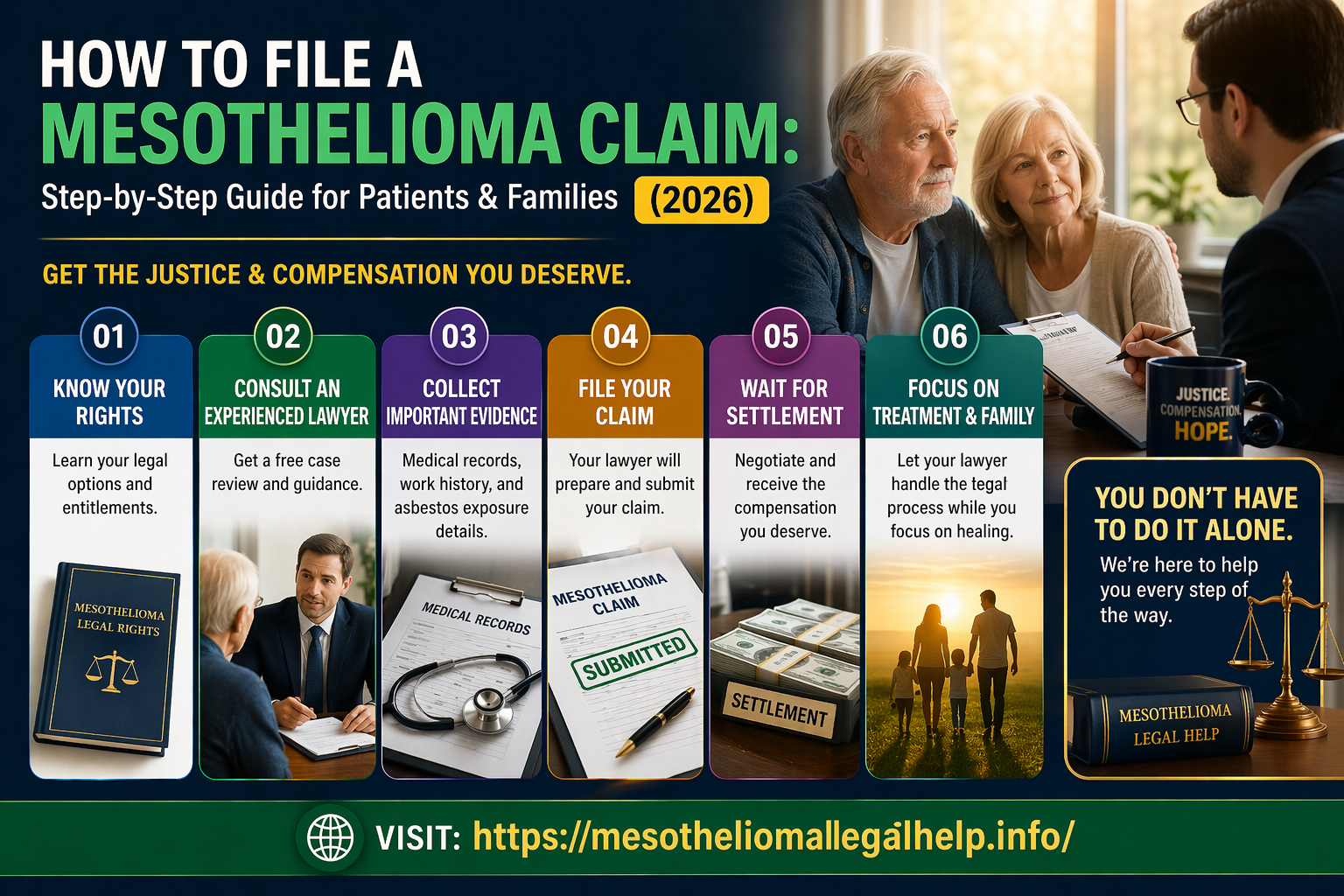
📅 Updated: April 2026 | ⏱ 10-minute read
Introduction
Reading about mesothelioma is one thing. Taking legal action is another, and for many families, it’s the step that feels the most daunting.
The truth is, filing a mesothelioma claim is not something you do alone, and it doesn’t have to be confusing. Experienced mesothelioma attorneys handle these cases every day. Their job is to carry the legal burden so you can focus on what matters most.
But you need to understand the process before you begin, what types of claims exist, what to expect at each stage, and why acting quickly is one of the most important decisions you can make.
This guide walks you through every step.
Step 1: Understand What Type of Claim You Can File
Before anything else, know that there isn’t just one type of mesothelioma claim. Most patients and families qualify for more than one, and filing multiple claims simultaneously is not only allowed, it’s standard practice and often the best way to maximize compensation.
Here are the four main claim types:
Personal Injury Lawsuit
Filed by someone diagnosed with mesothelioma against the companies responsible for their asbestos exposure. You don’t need to have worked directly for those companies, manufacturers of asbestos-containing products can also be held liable. Most cases settle out of court for $1 million to $2 million, typically within 6–18 months.
Wrongful Death Lawsuit
If a loved one has passed away from mesothelioma, their surviving family members or estate can file a wrongful death claim. These cover funeral costs, lost income, medical expenses, and pain and suffering. The filing window opens after death and is subject to its own statute of limitations, act quickly.
Asbestos Trust Fund Claim
Over 60 asbestos companies declared bankruptcy after being overwhelmed by lawsuits, but courts required them to set aside money before reorganizing. The result: over $30 billion sitting in dedicated trust funds, available specifically for people with asbestos-related diseases. Trust fund claims are filed separately from lawsuits, don’t go through the court system, and often pay out within 90 days to 12 months. You can file trust fund claims at the same time as a lawsuit without the two processes interfering with each other.
VA Disability Claim
If the diagnosed person is a veteran, they may qualify for monthly VA disability compensation, $4,158.17/month in 2026 for a veteran with 100% disability and a spouse. Filing a VA claim does not affect your right to also file a civil lawsuit or trust fund claim.
Step 2: Consult a Mesothelioma Attorney, For Free
This is the most important step, and it should happen before anything else.
Mesothelioma law is a specialized field. General personal injury attorneys often lack the investigative resources, case history, and asbestos product databases that dedicated mesothelioma law firms have built over decades. The right attorney can dramatically increase both the speed and the total amount of your compensation.
What to expect from a free consultation:
- The attorney reviews your diagnosis, medical history, and work/military background
- They identify which companies may be liable and which trust funds apply to your case
- They give you an honest assessment of what your claim is likely worth
- You decide whether to move forward, with no obligation
How mesothelioma attorneys charge: Almost universally on a contingency fee basis. That means you pay nothing upfront. The firm only receives a percentage of your settlement or verdict if and when you win. If you don’t win, you owe nothing.
Pro tip: Have a list of your employers, job sites, and military service history ready before your first consultation. Even rough details help attorneys begin mapping your exposure history.
Step 3: Gather Your Documentation
Once you retain an attorney, their team will do the heavy lifting, but the more information you can provide, the faster and stronger your case will be.
Key documents to collect:
| Document Type | Why It Matters |
|---|---|
| Medical records & diagnosis confirmation | Proves the mesothelioma diagnosis |
| Employment history & pay stubs | Establishes where and when asbestos exposure occurred |
| Military service records (Form DD214) | Required for VA claims and military exposure cases |
| Social Security work history | Helps attorneys trace decades-old employers |
| Product receipts or invoices | Links specific asbestos-containing products to your exposure |
| Witness contact information | Former coworkers can provide critical testimony |
Don’t worry if you can’t locate all of these. Your legal team has resources, including asbestos product databases, Social Security records requests, and networks of expert witnesses, specifically designed to reconstruct exposure history even when documents are decades old or missing.
Step 4: Your Attorney Files the Claim
After gathering evidence and building your case, your attorney files the appropriate claims on your behalf. This happens in parallel for different claim types, for example, a lawsuit against active companies can be filed at the same time as trust fund claims against bankrupt ones.
For a personal injury or wrongful death lawsuit:
- Your attorney files in the most favorable jurisdiction based on your exposure history and state laws
- The defendant companies are formally notified
- The discovery phase begins, both sides gather evidence, conduct depositions, and exchange documentation
- Most cases settle during or after discovery, before reaching trial
For asbestos trust fund claims:
- Your attorney submits your claim package directly to each applicable trust
- The trust reviews your documentation and diagnosis
- Approved claims are paid out on a schedule, often within 90 days for expedited processing
Step 5: Settlement or Trial
The vast majority of mesothelioma cases, over 95%, settle before trial. That means most families receive compensation without ever stepping into a courtroom.
When a settlement offer comes in, your attorney will walk you through whether it’s fair given your circumstances. You are never required to accept a settlement. If the offer doesn’t reflect the full value of your case, your attorney can push for a higher amount or proceed to trial.
If your case goes to trial:
- A jury hears the evidence and determines both compensatory and punitive damages
- Trial verdicts tend to be higher than settlements, but the timeline is longer (1–3 years)
- Recent 2026 verdicts like the $51 million Avon ruling and the $966 million J&J verdict show that juries take mesothelioma cases seriously
Step 6: Receive Your Compensation
Once a settlement is reached or a verdict is returned, your compensation is processed and distributed. Your attorney’s contingency fee is deducted at this stage, you never pay out of pocket.
Compensation from mesothelioma claims can cover:
- Past and future medical expenses
- Lost wages and reduced earning capacity
- Pain and suffering
- Loss of companionship (loss of consortium)
- Funeral and end-of-life costs (in wrongful death cases)
- Punitive damages (in cases of extreme corporate negligence)
The Single Biggest Mistake Mesothelioma Patients Make
Waiting too long.
Every state has a statute of limitations, a legal deadline for filing mesothelioma claims. For personal injury claims, this is typically 1 to 3 years from the date of diagnosis. For wrongful death claims, the clock usually starts at the date of death. Miss this window and you may lose your legal right to compensation entirely.
Beyond the deadline, delay also makes cases harder to build. Witnesses become harder to locate. Company records disappear. The sooner your legal team begins investigating, the stronger your case will be.
Common Questions About Filing a Mesothelioma Claim
What if I don’t know which company exposed me to asbestos?
This is extremely common. Mesothelioma attorneys specialize in tracing exposure through your full work and life history. You don’t need to know the answer before reaching out.
What if the company that exposed me is bankrupt?
Bankruptcy doesn’t mean you’re out of options. Bankrupt asbestos companies were required to establish trust funds before restructuring. Your attorney will identify which trusts apply and file on your behalf.
Can family members file if the patient has already passed away?
Yes. Surviving spouses, children, or estate representatives can file wrongful death claims. Contact an attorney as soon as possible, statutes of limitations apply here too.
Does filing a claim mean going to court?
Almost certainly not. More than 95% of mesothelioma cases settle out of court. Your attorney handles the process; you’re rarely required to appear anywhere.
Can I file if I’m already receiving VA benefits?
Yes. VA benefits and civil claims are entirely separate legal processes. Filing one does not affect your right to the other.
Read More:
Mesothelioma Payouts 2026 — Complete Guide to Compensation
Take the First Step Today
Filing a mesothelioma claim won’t undo the harm caused by asbestos exposure, nothing can. But it holds the companies responsible for that exposure accountable, and it gives your family the financial security to focus on what matters most.
With over $30 billion available in asbestos trust funds and settlements regularly reaching $1 million or more, most families who pursue claims receive meaningful compensation. And with contingency-fee attorneys, there’s no financial risk to finding out what you’re owed.
The only risk is waiting too long.
This article is for informational purposes only and does not constitute legal advice. Consult a licensed mesothelioma attorney for guidance specific to your situation.