
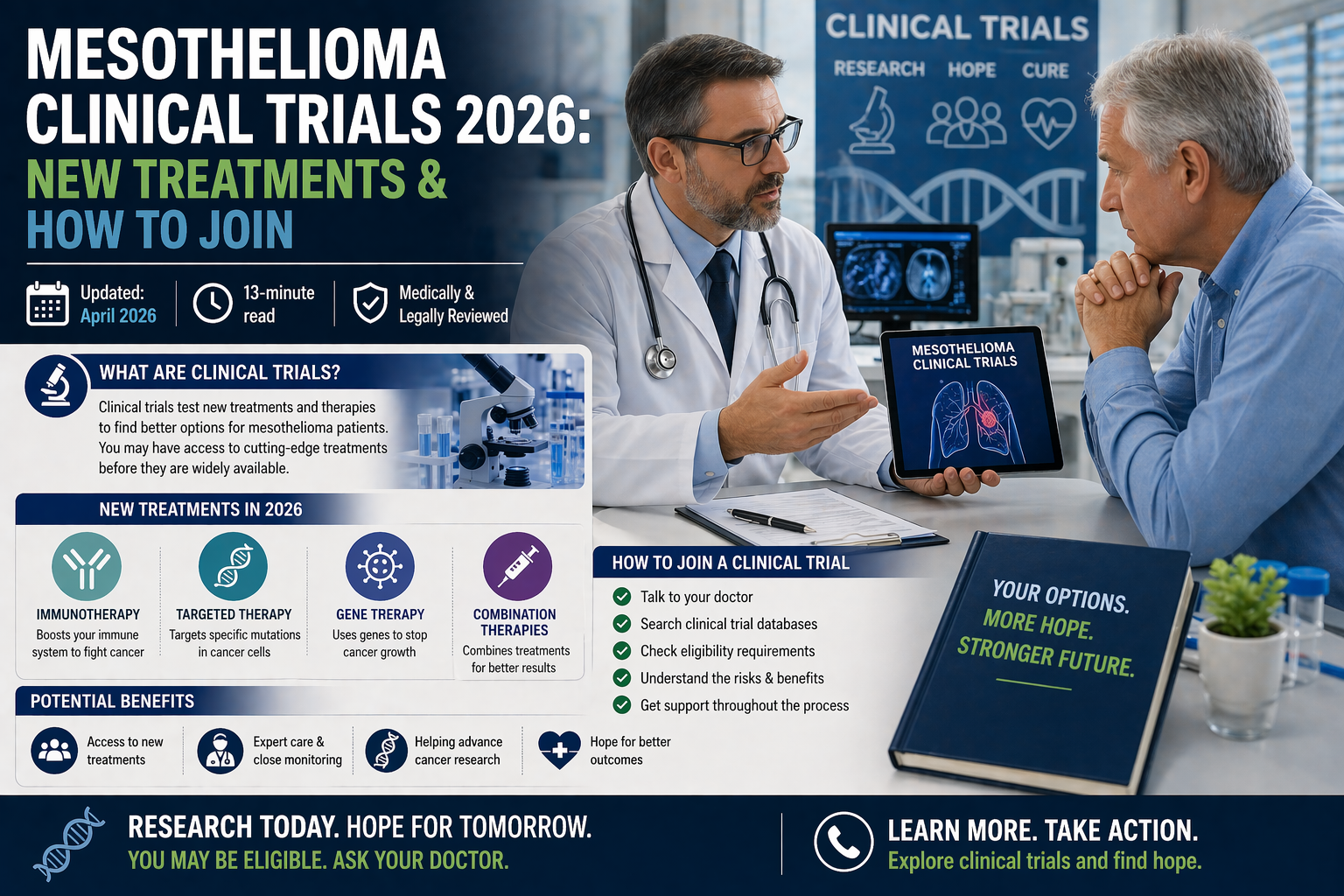
📅 Updated: April 2026 | ⏱ 13-minute read | ✅ Medically & Legally Reviewed
Introduction
Mesothelioma Clinical Trials 2026 In 2020, the FDA approved the first new mesothelioma treatment in 16 years. In 2024, ASCO updated its mesothelioma treatment guidelines for the first time since 2018. In March 2026, five-year data from the landmark CheckMate 743 trial confirmed that 14% of patients on immunotherapy are still alive five years after treatment, more than double the 6% survival rate with chemotherapy.
Every one of these advances started as a clinical trial.
Right now, more than 53 mesothelioma clinical trials are actively recruiting patients across the United States, testing cancer vaccines, CAR T-cell therapies, novel immunotherapy combinations, gene therapies, and new surgical approaches. Most are free to participate in. All give patients access to cutting-edge treatments that aren’t available through standard care.
And yet, according to a 2025 survey by The Mesothelioma Center, only 8% of mesothelioma patients participate in a clinical trial. That means 92% of patients never know what they might have had access to.
This guide changes that. Here’s everything you need to know about mesothelioma clinical trials in 2026, what’s available, how to qualify, how to join, and what financial help is available while you’re enrolled.
Why Mesothelioma Clinical Trials Matter More Than Ever in 2026
Clinical trials are not a last resort. They are not experimental gambling. They are the structured, FDA-regulated pathway through which every major mesothelioma treatment advance has arrived, and they represent the frontier of what’s possible for patients diagnosed today.
Every standard mesothelioma treatment in use today was once a clinical trial:
- Pemetrexed + cisplatin (standard chemotherapy since 2004), began as a clinical trial
- Nivolumab + ipilimumab (FDA-approved 2020), began as CheckMate 743
- HIPEC for peritoneal mesothelioma (achieving 65% 5-year survival), refined through clinical trials
The treatments being tested in 2026 are what patients in 2030 and 2035 will consider standard of care. Joining a trial today means accessing tomorrow’s medicine now, under full medical supervision, at no upfront cost.
How Mesothelioma Clinical Trials Work
The Four Trial Phases
Every new treatment goes through a staged testing process before it can be approved:
| Phase | Purpose | Typical Participants | What’s Being Tested |
|---|---|---|---|
| Phase I | Safety and dosing | 15–30 patients | Is it safe? What dose works? |
| Phase II | Effectiveness | 30–100 patients | Does it work? What are the side effects? |
| Phase III | Comparison to standard care | 100–1,000+ patients | Is it better than current treatment? |
| Phase IV | Post-approval monitoring | Thousands | Long-term safety and effectiveness |
Most actively recruiting mesothelioma trials in 2026 are in Phase I/II or Phase II/III, the stages where promising treatments are being tested against current standards.
Who Oversees Clinical Trials?
Every mesothelioma clinical trial must be:
- Approved by the FDA before it begins
- Reviewed by an Institutional Review Board (IRB), an independent ethics committee
- Registered on ClinicalTrials.gov, the US National Institutes of Health database
- Conducted under Good Clinical Practice (GCP) standards, the international quality standard for clinical research
You can withdraw from any trial at any time without penalty, and your ability to access other treatments is never restricted by participating in a trial.
Active Mesothelioma Clinical Trials 2026, The Most Promising Treatments
1. Immunotherapy Combinations, Expanding Beyond CheckMate 743
The FDA approval of nivolumab + ipilimumab was a watershed moment. In 2026, researchers are now pushing further, testing new immunotherapy combinations that may deliver even better results:
Volrustomig (MEDI5752) + Carboplatin + Pemetrexed
- What it is: A dual checkpoint inhibitor targeting both PD-1 and CTLA-4 simultaneously, similar to but distinct from nivolumab + ipilimumab
- Trial: Global Phase III study comparing Volrustomig + chemo vs. standard chemotherapy or nivolumab + ipilimumab
- Who can join: Unresectable pleural mesothelioma, no prior systemic therapy
- Locations: Multiple US states, actively recruiting
- NCT: Contact ClinicalTrials.gov for current NCT number
Pembrolizumab + Pemetrexed + Platinum (KEYNOTE-483)
- What it is: Adding Keytruda (pembrolizumab) to standard pemetrexed-platinum chemotherapy as a first-line combination
- Results so far: Median overall survival 17.3 months vs. 16.1 months with chemotherapy alone; FDA approved this combination as an additional first-line option in 2025
- Significance: Gives oncologists a chemoimmunotherapy option, particularly valuable for epithelioid mesothelioma where chemotherapy remains important
Durvalumab + Tremelimumab ± Chemotherapy (Neoadjuvant)
- What it is: Testing dual immunotherapy, with or without chemotherapy, before surgery to shrink tumors and improve surgical outcomes
- Trial phase: Phase II/III
- Location: MD Anderson Cancer Center, Houston TX, actively recruiting
- Ideal for: Resectable pleural mesothelioma patients planning surgery
Pembrolizumab + Chemotherapy + Image-Guided Surgery
- What it is: Combining pembrolizumab immunotherapy with surgery and chemotherapy in a novel multimodal approach
- Location: Philadelphia, PA
- Target: Resectable pleural mesothelioma
- Goal: Determine whether adding immunotherapy to surgery improves long-term survival beyond what surgery + chemo alone achieves
2. UV-1 Cancer Vaccine, FDA Fast Track Designated
One of the most exciting mesothelioma clinical trials of 2026 involves a cancer vaccine, a concept that just a decade ago seemed science fiction for solid tumors.
What it is: UV-1 is a peptide-based cancer vaccine developed by Ultimovacs that triggers the immune system to attack cells expressing human telomerase reverse transcriptase (hTERT), a protein overexpressed in mesothelioma and many other cancers.
How it works: Patients receive UV-1 injections alongside standard immunotherapy (nivolumab + ipilimumab). The vaccine “trains” the immune system to recognize and destroy mesothelioma cells more aggressively than immunotherapy alone.
Current data (NIPU Phase II Trial):
| Metric | UV-1 + Immunotherapy | Immunotherapy Alone |
|---|---|---|
| Median Overall Survival | 15.4 months | 11.1 months |
| Objective Response Rate | 31% | 16% |
| Disease Control Rate | Higher | Lower |
Status: FDA granted Fast Track designation in February 2024, recognizing UV-1 as addressing a serious unmet medical need and expediting its path to approval. A Phase III trial is expected to launch, providing the definitive data needed for full FDA approval.
What Fast Track means for patients: Faster communication between the sponsor and FDA, rolling review of trial data, and priority review once sufficient data is available, all of which could bring this treatment to patients sooner.
3. CAR T-Cell Therapy, Mesothelioma’s Most Transformative Emerging Treatment
CAR T-cell therapy has already produced dramatic, documented cures in certain blood cancers. For mesothelioma, it represents the most potentially transformative therapy currently in clinical development.
How it works:
- A sample of the patient’s own T-cells (immune cells) is extracted from the blood
- In a laboratory, the T-cells are genetically modified to produce chimeric antigen receptors (CARs), receptors that specifically recognize mesothelin, a protein overexpressed on the surface of mesothelioma cells
- The modified CAR T-cells are multiplied into millions of cells
- They are infused back into the patient, where they seek out and destroy mesothelioma cells throughout the body
SynKIR-110 (KIR-CAR T-Cell Therapy)
A new variation presented at AACR 2026 uses an innovative KIR-CAR design that showed safety and increasing efficacy at higher doses across multiple solid tumor types including mesothelioma.
- Current trial: First-in-human Phase I trial, SynKIR-110 for mesothelin-expressing cancers including mesothelioma
- Location: Philadelphia, Pennsylvania, actively recruiting
- Eligibility: Advanced mesothelioma expressing mesothelin; specific prior treatment requirements apply
- What’s being measured: Safety, tolerability, and preliminary efficacy
“We have one client that was recently cured using this therapy.”, Christopher M. Placitella, mesothelioma attorney, Cohen, Placitella & Roth (April 2026)
4. Targeted Molecular Therapy, Attacking Mesothelioma’s Genetic Vulnerabilities
Mesothelioma has specific genetic mutations, particularly in BAP1, NF2, and CDKN2A, that can be targeted with drugs designed to exploit those weaknesses.
Olaparib for HRD (Homologous Recombination Deficiency) Mesothelioma
- What it is: A PARP inhibitor that targets mesothelioma cells with specific DNA repair defects (HRD mutations)
- Trial phase: Active Phase II trial
- Location: Chicago, Illinois, actively recruiting
- Eligible patients: Mesothelioma with confirmed HRD mutations (tested from tumor biopsy)
- Why it matters: HRD mutations are found in a subset of mesothelioma patients who are likely to respond poorly to chemotherapy but may respond well to PARP inhibition
TEAD Inhibitors (Hippo Pathway)
- What it is: Drugs targeting the Hippo signaling pathway, which is disrupted by NF2/Merlin mutations found in approximately 40% of mesothelioma tumors
- BGC515 (TEAD inhibitor), Phase I trial actively recruiting at MD Anderson Cancer Center, Houston TX
- Why it matters: NF2-mutant mesothelioma has historically been resistant to most treatments; TEAD inhibition directly targets this vulnerability
BAP1 Gene Therapy
- Multiple Phase I/II trials are investigating introducing functional BAP1 tumor suppressor genes into mesothelioma cells, restoring cancer-fighting function that the disease has knocked out
- Locations: Several major cancer centers, search ClinicalTrials.gov for current NCT numbers
5. Tumor Treating Fields (TTFields), FDA Approved, Now Being Expanded
TTFields (Tumor Treating Fields) use low-intensity, alternating electric fields delivered through a wearable device worn on the torso to disrupt cancer cell division. The device is non-invasive, worn at home, and does not cause the systemic side effects of chemotherapy.
Current status:
- The NovoTTF-100L system received FDA humanitarian device exemption for unresectable pleural mesothelioma
- The STELLAR trial demonstrated median overall survival of 18.2 months when TTFields was combined with pemetrexed-platinum chemotherapy, meaningfully extending survival compared to chemotherapy alone
2026 trials: Multiple studies are now evaluating TTFields combined with immunotherapy, testing whether combining the device’s mechanism of disrupting cell division with immunotherapy’s immune activation produces additive or synergistic survival benefits.
6. Antibody-Drug Conjugates (ADCs), Precision Payload Delivery
Antibody-drug conjugates attach a chemotherapy drug directly to an antibody that seeks out mesothelioma-specific proteins, delivering chemotherapy precisely inside cancer cells while sparing normal tissue.
Sacituzumab Govitecan
- What it is: An ADC targeting TROP-2, a protein expressed on mesothelioma cells
- Trial: Actively recruiting in New York and New Jersey
- Phase II: Measuring how many mesothelioma tumors shrink or disappear completely
- Why it’s exciting: TROP-2 targeted therapy has shown dramatic responses in breast and lung cancer; mesothelioma trials are the logical next step
7. Peritoneal Mesothelioma, Trials Focused on HIPEC Optimization
For peritoneal mesothelioma patients, clinical trials in 2026 are focused on pushing the already-impressive CRS-HIPEC survival rates even higher:
Post-CRS-HIPEC Chemotherapy Optimization
- Testing whether intraperitoneal (IP) or intravenous (IV) chemotherapy after CRS-HIPEC provides additional survival benefit
- Location: Memorial Sloan Kettering, New York City, actively recruiting
Immunotherapy + Chemotherapy for Peritoneal Mesothelioma
- Comparing standard chemotherapy alone to atezolizumab + bevacizumab for peritoneal patients, testing whether immunotherapy provides the same peritoneal benefit it has shown in pleural disease
- Location: University of Chicago, actively recruiting
HIPEC Drug Optimization (SMART System)
- Using a novel “SMART” system to individualize which chemotherapy drugs are used in HIPEC based on the specific molecular characteristics of each patient’s tumor
- Location: NIH/NCI, Bethesda, Maryland, actively recruiting
PIPAC (Pressurized Intraperitoneal Aerosol Chemotherapy)
- For peritoneal patients not eligible for traditional CRS-HIPEC; delivers aerosolized chemotherapy directly into the abdominal cavity under pressure via laparoscopic ports
- Multiple Phase II trials ongoing, dramatically lower surgical burden than traditional HIPEC
Who Is Eligible for a Mesothelioma Clinical Trial?
Eligibility varies by trial, but the good news is that most mesothelioma patients qualify for at least one active trial, and many qualify for several simultaneously.
General Eligibility Requirements
| Criteria | What’s Evaluated |
|---|---|
| Confirmed diagnosis | Pathology report confirming mesothelioma and cell type (epithelioid/sarcomatoid/biphasic) |
| Performance status | ECOG score, how well you can perform daily activities (typically 0–2 required) |
| Organ function | Heart, lungs, kidneys, liver must function adequately, confirmed by recent bloodwork |
| Prior treatments | Which therapies you’ve already received; some trials require no prior treatment, others specifically want previously treated patients |
| Disease type | Pleural, peritoneal, or other, most trials target one specific type |
| Stage | Some trials are stage-specific; others are open to all stages |
| Biomarkers | Some trials require specific genetic mutations (BAP1, NF2, HRD), tested from your tumor biopsy |
| Age | Most trials are open to adults 18+; some have upper age limits |
Inclusion and Exclusion Factors
You may be excluded from specific trials if you have:
- Active autoimmune disease requiring systemic treatment
- Prior organ transplant (for some immunotherapy trials)
- Received a specific drug being tested (to avoid confounding results)
- Active brain metastases in some cases
Key point: Being excluded from one trial doesn’t mean you’re excluded from all of them. Your mesothelioma specialist evaluates multiple trials simultaneously to find the best match for your specific diagnosis.
What Does a Clinical Trial Cost?
The short answer: clinical trials are typically free or heavily subsidized for participants.
| Cost Category | Who Pays |
|---|---|
| Study drug or device | Paid by the trial sponsor, free to patient |
| Study-related tests and labs | Paid by the trial sponsor |
| Routine care during trial | Billed to your health insurance (Medicare, Medicaid, commercial) |
| Travel to trial site | Some sponsors provide assistance; varies by trial |
| Lodging | Some major cancer centers offer housing assistance for out-of-town patients |
Medicare coverage: By law, Medicare must cover routine costs associated with clinical trial participation for Medicare beneficiaries. This includes standard care items and services that would normally be covered outside of a trial.
Commercial insurance: Most major insurers cover routine care costs during clinical trials, particularly for FDA-regulated trials involving life-threatening conditions.
Mesothelioma Trial Compensation, What Financial Help Is Available?
Beyond free treatment during the trial itself, mesothelioma patients have access to significant financial compensation that can be pursued simultaneously with trial participation:
| Source | Amount |
|---|---|
| Asbestos Lawsuit Settlement | $1M – $1.4M average |
| Trial Verdict | $5M – $11.4M average |
| Asbestos Trust Funds | $300K – $400K combined |
| VA Benefits (veterans) | $4,158.17+/month |
| Combined Total | $1.5M – $2M+ |
Clinical trial participation does not affect your legal rights. You can pursue full legal compensation from asbestos manufacturers while simultaneously enrolled in a clinical trial. Many families use their asbestos compensation to cover travel costs, caregiving support, and out-of-pocket expenses during trial participation.
How to Find and Join a Mesothelioma Clinical Trial
Step 1, Talk to a Mesothelioma Specialist
Your first step is a consultation with a specialist at a major mesothelioma treatment center, not a general oncologist. Mesothelioma specialists know which trials are open, which match your diagnosis, and can pre-screen you for eligibility during your appointment.
Leading centers with active trial programs in 2026:
| Center | Location | Specialty |
|---|---|---|
| MD Anderson Cancer Center | Houston, TX | All types; largest trial portfolio |
| Memorial Sloan Kettering | New York, NY | Pleural and peritoneal |
| Moffitt Cancer Center | Tampa, FL | Surgery + immunotherapy trials |
| Penn Medicine / Abramson Cancer Center | Philadelphia, PA | CAR T-cell therapy, surgery trials |
| Brigham and Women’s Hospital | Boston, MA | Pleural surgery + systemic therapy |
| University of Chicago | Chicago, IL | Peritoneal immunotherapy trials |
| NIH / NCI | Bethesda, MD | BAP1 genetics, HIPEC optimization |
Most of these centers offer remote/telemedicine consultations, you don’t need to travel just to be evaluated.
Step 2, Search ClinicalTrials.gov
The US National Institutes of Health maintains a complete database of all registered clinical trials:
Website: ClinicalTrials.gov
How to search effectively:
- Search “mesothelioma” as your condition
- Filter by “Recruiting” status, only shows trials currently accepting patients
- Filter by your ZIP code or state to find trials near you
- Filter by trial phase (Phase II or III for more advanced trials)
- Note the NCT number of any trial that interests you, bring this to your appointment
Step 3, Pre-Screen for Eligibility
Once you’ve identified trials of interest, your medical team or the trial’s research coordinator runs a pre-screening:
- Review of your pathology report and cell type
- Review of your performance status and recent lab work
- Review of your prior treatment history
- Possible additional biomarker testing (genetic testing of your tumor)
Pre-screening is free and carries no obligation.
Step 4, Informed Consent
If you’re eligible and interested, you review and sign an informed consent document, a plain-language explanation of:
- What the trial involves and what’s being tested
- All known and potential risks
- What you’ll be required to do (visit schedule, tests, etc.)
- Your right to withdraw at any time without consequence
Take time to read this carefully. Ask every question you have. You can take the document home and discuss it with your family before signing.
Read More: Peritoneal Mesothelioma: Symptoms, Treatment & Compensation Guide 2026
Step 5, Baseline Testing Begins
Once enrolled, your research team performs baseline assessments, imaging, bloodwork, and clinical measurements, to establish your starting point. Treatment then begins according to the trial protocol.
Questions to Ask Before Joining a Mesothelioma Trial
Bring these questions to your consultation:
- What phase is this trial, and what is it trying to prove?
- How does this treatment compare to what I’d receive with standard care?
- Will I know which treatment arm I’m in, or is this blinded?
- What are the known side effects of this treatment so far?
- How often will I need to visit the trial site? Can any testing be done locally?
- What happens to my care if the trial stops early?
- Can I continue the treatment after the trial ends if it’s working?
- Does this trial have any impact on my ability to file a legal claim? (Answer: No.)
- Are there travel or lodging assistance programs?
- What other trials would I qualify for if this one doesn’t work?
Real Patient Outcomes From Mesothelioma Clinical Trials
“I was a real mess when first diagnosed. Hardly a will to live. The oncologist didn’t think I’d last 30 days. I started Keytruda [in a clinical trial], and almost immediately things changed for the better. You could feel it. Something worked for me.”
, Ron Green, mesothelioma survivor
“Clinical trials are going to be the avenue to making progress with this disease. I think they are great.”
, Kathy Angerman, mesothelioma survivor
Documented clinical trial outcomes that changed mesothelioma treatment:
- CheckMate 743: 14% of patients alive at 5 years with nivolumab + ipilimumab, vs. 6% with chemotherapy (March 2026 data)
- STELLAR (TTFields): 18.2-month median survival with TTFields + chemotherapy
- NIPU (UV-1 vaccine): 31% response rate, nearly double the 16% rate with immunotherapy alone
- CRS-HIPEC trials: 65% 5-year survival for optimal peritoneal candidates, from what was once a universally fatal diagnosis within 12 months
Frequently Asked Questions
What is the most promising mesothelioma clinical trial in 2026?
Several trials stand out. The UV-1 cancer vaccine (FDA Fast Track designated) nearly doubled response rates in Phase II. KIR-CAR T-cell therapy (SynKIR-110) is showing safety and early efficacy signals for mesothelin-expressing mesothelioma. The Volrustomig Phase III trial is the largest global study directly comparing a new immunotherapy combination against current standards.
Can I join a clinical trial if I’ve already had chemotherapy?
Yes, many trials specifically target previously treated patients. Some immunotherapy trials require that patients have already tried chemotherapy. Others specifically want treatment-naive patients. Your eligibility depends on which trial you’re applying for, not whether you’ve had prior treatment in general.
Do clinical trials give placebos?
Not in mesothelioma trials. Given the severity of the disease, patients in cancer clinical trials always receive some form of active treatment. You may receive the experimental treatment, the standard treatment, or a combination, but you will never receive no treatment.
How long does a mesothelioma clinical trial last?
This varies significantly by trial, from several months for early-phase trials to several years for Phase III comparative studies. You can withdraw at any time, and your enrollment doesn’t prevent you from starting other treatments if the trial isn’t working for you.
Does joining a trial affect my legal compensation rights?
No. Your legal rights to pursue asbestos lawsuits, trust fund claims, and VA benefits are completely unaffected by clinical trial participation. Many patients pursue legal compensation while enrolled in a trial, using settlement funds to cover travel, caregiving, and quality-of-life expenses during treatment.
What if I don’t qualify for any current trials?
Ask your specialist to re-evaluate you periodically, new trials open frequently, and your eligibility may change as your treatment history evolves. Ask about compassionate use or expanded access programs, which can provide access to experimental therapies outside of a formal trial setting in certain circumstances.
Access Tomorrow’s Treatments Today
Clinical trials represent the leading edge of what medicine can do for mesothelioma. Every breakthrough that exists today, from chemotherapy to HIPEC to immunotherapy, began as a trial that patients chose to join.
In 2026, the next breakthroughs are in progress right now. CAR T-cell therapy may cure mesothelioma in some patients. The UV-1 vaccine may double response rates. New TEAD inhibitors may unlock treatment for NF2-mutant tumors that don’t respond to anything currently available.
These treatments are available to patients today, free of charge, under full medical supervision, at major cancer centers across the country.
The question isn’t whether trials are worth considering. The question is which trial is right for you.
The firms connected through this site work with mesothelioma specialists across the country and can help connect you with clinical trial access, alongside pursuing the full legal compensation your family deserves. At zero upfront cost.
👉 Mesothelioma Statute of Limitations by State 2026: Don’t Miss Your Deadline
About the Author
Brian Watson is a senior research editor at MesotheliomaLegalHelp.info with over eight years of experience covering legal and medical topics for digital health publications. He specializes in asbestos litigation, occupational disease, veterans’ benefits, and mesothelioma treatment research. Brian’s work is reviewed against current medical literature, legal precedent, and publicly available case data before publication. He holds a degree in journalism with a concentration in health and science writing.